



Your Warsaw deed
starts at a
Korean FX bank.
A South Korea-specific buyer brief for classifying the Polish asset, clearing the Korean foreign-property route, documenting KRW funding, closing through an apostilled authority and keeping the later tax record aligned.
A citizen of the Republic of Korea can usually buy a legally independent Warsaw apartment without Poland's foreign-purchaser permit. A house, plot or acquisition structure that includes land normally starts on the permit track. That first conclusion comes from the asset and the buyer, not from a listing headline. Poland's Ministry of the Interior identifies a separate residential unit among the statutory exemptions while explaining the general permit procedure for non-EEA and non-Swiss purchasers: official MSWiA guidance for foreign buyers.
The Korean side creates a second gate. For a Korean resident, an overseas property purchase is generally a regulated capital transaction that must be reported through the appropriate Korean foreign-exchange route before the acquisition funds move. The current Foreign Exchange Transactions Regulations, effective 6 July 2026, keep the overseas-real-estate procedure in Articles 9-39 and 9-40: official Korean legal text. The buyer's Korean residence status, use of the property, source, remitting bank and payment sequence must therefore be fixed before a Polish deposit becomes exposed.
Confirm whether the Polish title is a separate apartment or land-linked property. Build a Korean bank file showing the owner, purpose, signed contract, price, source and beneficiary. Make any deposit conditional on the correct Korean reporting route and Polish due diligence. If closing remotely, let the Polish notary approve the authority before execution and apostille in Korea. After remittance, complete the Korean acquisition report and maintain one evidence room for Polish tax, Korean tax and the eventual sale.
Passport, residence and ownership cannot be collapsed into one label
"Korean buyer" may describe citizenship, address, bank location or tax residence. The transaction needs the exact answer to each.
Who is acquiring the Warsaw asset?
Record citizenship, Korean residence for foreign-exchange purposes, tax residence, marital status, co-buyers, ownership shares, beneficial owner and signing authority. A Korean citizen resident in Seoul, a Korean national who is already non-resident for Korean FX purposes, a spouse with another passport and a Korean corporation do not enter the same reporting, permit or tax route.
What exactly will the deed transfer?
Identify the legal unit, register number, use classification and every accessory or separate right. An offer described as an apartment may include a garage share, storage unit, garden interest, commercial unit or land co-ownership. Each component can change permit exposure, lender acceptance, taxes and exit.
Before viewing, prepare a controlled English file with the buyer's passport, Korean residence status, owner and shares, acquisition purpose, maximum PLN price, KRW source, remitting bank, financing assumption, signing method and rejection rules. Add Korean translations or bank forms where the designated institution requires them. The Polish and Korean teams should work from the same facts.
The apartment exemption ends where land begins
The legal object controls the route. Intended use, marketing language and physical appearance do not replace the title structure.
| Proposed acquisition | Starting position | Control before commitment |
|---|---|---|
| Korean citizen buying a separate Warsaw residential unit | Usually permit-exempt | Verify independent-unit status, register, location, co-buyers and every related right. |
| House with its plot | Permit normally required | Test personal exemptions, land classification, access, planning and Ministry timing. |
| Vacant, development or agricultural land | Permit normally required | Review size, regulated-land rules, intended use, utilities, road access and evidence of ties with Poland. |
| Apartment plus separately structured garage, storage or garden right | Component review | Identify whether the addition is appurtenant, a separate unit, a share or an interest in land. |
| Joint purchase or Korean company | Each acquirer tested | Resolve nationality, corporate control, beneficial ownership, shares, authority and Korean reporting separately. |
The Ministry's Polish-language procedure lists the permit evidence, including documents identifying the property and buyer, proof of ties with Poland and evidence of funds. It also explains the need for sworn translations into Polish: official MSWiA permit procedure. Where a permit may be needed, the preliminary agreement must allocate the timetable, seller cooperation, deposit protection and the consequences of refusal.
Read the live Polish register
The Ministry of Justice explains the four sections of the land-and-mortgage register: the property and related rights, ownership, claims and restrictions, and mortgages. Use the current register and inspect every pending mention: official land-register guidance and EKW access.
Separate permission from due diligence
An exemption says only that this acquisition does not need that administrative permit. It does not verify seller authority, mortgage release, occupancy, arrears, building liabilities, legality of alterations, technical condition, price or the agreed payment mechanism.
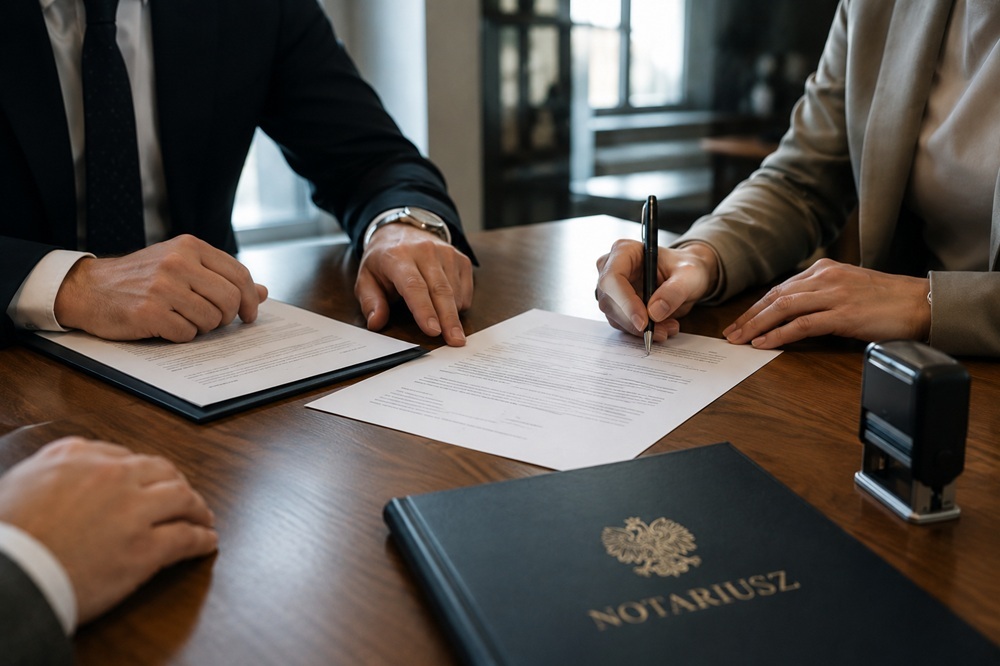
Reserve only the verified legal asset. If the register, garage structure or intended purchaser is still unclear, the payment should remain refundable or conditional until the classification is confirmed in writing.
The bank file must be ready before KRW becomes PLN
The important question is not whether money can cross a border. It is whether the correct Korean authority, documents and post-closing reports have been designed around the real transaction.
The Bank of Korea explains that a resident acquiring overseas real estate for non-residential purposes, or a residence for the buyer or spouse's overseas stay, follows a report-and-acceptance route through a designated foreign-exchange bank; other non-exempt cases may go to the Bank of Korea. Its current capital-transactions page also lists the principal exceptions: Bank of Korea guidance on real-estate acquisition. Because the buyer's residence and purpose determine the route, the sending bank should issue a transaction-specific checklist before the Polish agreement sets hard dates.
Fix Korean FX residence
Citizenship alone is insufficient. Confirm whether the purchaser is a resident or non-resident for the Foreign Exchange Transactions Act and whether any exception applies to the acquisition.
Choose the designated bank
Ask the institution that will accept the overseas-property report to name its required forms, review team, document language, processing time, remittance route and post-acquisition obligations.
Match contract to report
The buyer, seller, asset, price, deposit, instalments, purpose and beneficiary in the Korean file must reconcile with the Polish reservation, preliminary agreement and deed. Explain any change before the next transfer.
Prove the economic source
Salary savings, business dividends, asset-sale proceeds, inheritance, gift and loan need different evidence. The source owner must match the buyer or be connected through documented lawful funding.
Control conversion and value date
Compare KRW-to-PLN and any two-leg route on the delivered PLN amount, spread, fees, intermediary deductions, cut-off, value date and cancellation risk. Set an authority limit and currency buffer.
Close the reporting loop
The current regulation requires the overseas-property acquisition report within three months after remittance of the acquisition funds in reportable cases, with later reports for disposal or change: current Korean regulation, Articles 9-39 and 9-40.
The National Bank of Poland publishes the won in units of 100 KRW in its official Table A. That is useful as a public accounting reference, not as a bank quote or guaranteed execution rate: NBP exchange-rate tables. A Korean purchase sheet should show the original KRW source, conversion date and rate, all fees, net PLN delivered and variance against the deed obligation.
| Korean file moment | Core evidence | Polish dependency | Failure to avoid |
|---|---|---|---|
| Before offer | Residence status, purpose and bank checklist | Correct buyer and legal asset | Promising a transfer route that the bank has not accepted |
| Before deposit | Draft or signed contract and source evidence | Refund protection and verified beneficiary | Non-refundable payment before asset or reporting clearance |
| Before deed | Accepted report, remittance instruction and FX authority | Final deed, mortgage release and payment schedule | Last-minute mismatch of amount, owner, account or value date |
| After remittance | Acquisition report, deed, payment and registration evidence | Final title and handover file | Assuming the bank transfer ended the Korean obligation |
| During ownership | Tax statement, rent, value and operating records | Polish tax and property accounts | Keeping different figures in Poland and Korea |
One signed schedule should reconcile contracted PLN, gross KRW sold, conversion route, rate, fees, expected net PLN, beneficiary, payment reference, sender and evidence owner. Preserve formal bank confirmations and SWIFT or transfer records with the deed.
Draft in Warsaw, execute in Korea, verify before closing
Apostille authenticates a document's origin. Only the Polish transaction notary can confirm that the authority fits the deed.
Article 158 of Poland's Civil Code requires a real-estate transfer agreement to be executed as a notarial deed. The current text appears in the government's ELI legal database. A buyer who cannot attend should therefore start with the notary for the Warsaw deed and obtain an accepted transaction-specific power, rather than adapting a generic Korean form.
Korea and Poland use apostille
The Polish Embassy in Seoul confirms that both states are parties to the Hague Apostille Convention and identifies the Overseas Koreans Agency as the Korean competent authority: official Embassy guidance. Korea's government e-Apostille service explains eligible documents, issuance and certificate verification.
Authentication does not repair scope
The power must address the exact property, owner and share; price and negotiation limits; deposits and payment; mortgage-release mechanics; possession; declarations; land-register applications; tax or utility steps where intended; substitute authority; and any conflict controls. The notary may require originals and a Polish sworn translation.
Freeze the closing data
Identify seller, buyer, property, shares, price, payment, possession, mortgage release, register filings and every declaration the representative must make.
Obtain the notary's approved version
Confirm form, wording, spouse or company evidence, originals, expiry assumptions, apostille, translation and interpreter requirements in writing.
Execute through the accepted Korean route
Do not let a local formatting change alter the scope. Send every revision back to the Polish deed notary before signature.
Obtain and verify the apostille
Use the current Overseas Koreans Agency process, preserve the complete original or accepted electronic chain and verify the certificate where applicable.
Translate and preflight
Arrange the Polish sworn translation, deliver originals early and run a final deed, authority and funds rehearsal before any irreversible transfer.
If the Polish notary rejects or changes the power, the Korean execution, apostille, translation and courier cycle may need to be repeated. Treat the approved authority as a version-controlled closing document.
The correct funding route cannot rescue the wrong apartment
Legal clearance and bank acceptance are gates. The investment still has to survive building, unit, contract, delivery and operating evidence.
Write the investment instruction
Fix use, target occupant, maximum PLN exposure, KRW funding source, hold period, acceptable yield, works reserve and hard rejection rules.
Screen the street and building
Compare transport, services, noise and competing supply with community finances, planned works, maintenance, charges, lift, security and realistic resale depth.
Inspect the unit technically
Test layout, daylight, moisture, ventilation, windows, heating, electrics, plumbing, structure indicators, alterations, measurements and the true works scope.
Verify seller and title
Review identity, authority, acquisition deed, register, pending mentions, claims, mortgages, occupancy, arrears, leases and the exact mortgage-discharge evidence.
Negotiate conditions, not only price
Define the legal asset, deposit character, reporting and permit conditions, due-diligence dates, documents, vacant possession, payment sequence, defects and default remedies.
Dry-run deed, bank and handover
Approve authority, deed, interpreter, remittance, beneficiary, registration, keys, meters, inventory, insurance, utilities and post-closing reporting before the critical date.
Our Buying Process in Warsaw guide explains the Polish sequence. A Korean buyer should add two explicit workstreams: a designated-bank and KRW reporting track, plus an apostilled authority track if the deed is remote. Neither should live only in messages between advisers.
The asking price is only one PLN line
Compare assets after tax, Korean bank execution, Polish closing, works, furnishing, vacancy and the cost of managing across seven or eight time zones.
| Budget line | Resale apartment | Developer apartment | Korean control |
|---|---|---|---|
| Purchase tax | Normally 2% PCC unless a statutory exemption applies | VAT treatment is generally reflected in the price; confirm the contract | Have the notary or tax adviser confirm classification before final remittance |
| Notary and registration | Deed fee, copies, filings and court fees | Deed fee, copies, filings and court fees | Add Korean execution, apostille, translation, interpreter and courier where needed |
| Professional control | Legal, technical and valuation scopes | Developer, contract, snagging and handover review | Budget bilingual reporting, bank coordination and remote approvals |
| Capital works | Condition-led renovation plus contingency | Fit-out, variations, lighting, storage and snagging | Use milestones, dated evidence, holdbacks and approval limits in PLN |
| Currency and bank | KRW source converted into contracted PLN | Often staged PLN instalments | Include spread, fees, value date, transfer risk and a rate buffer |
| Operations | Community charges, utilities, insurance, property tax and management | Same after delivery, plus warranty control | Fund a Polish reserve so routine obligations do not depend on each KRW transfer |
Poland's Ministry of Finance publishes the standard 2% PCC rate for real-estate sales in its official PCC rates. The statutory maximum notarial tariff appears in the government legal database. A notary's quote may be lower and should also itemise VAT, certified copies and court fees.
Model the asset in PLN
The apartment earns rent, pays charges and incurs repairs in Poland. Keep the operating model in PLN, then translate capital contributions, distributions and value into KRW at stated dates and rates. Mixing currencies inside the same return line hides performance.
Do not assume a PLN mortgage
Poland's financial supervisor says mortgage credit should be granted or indexed only in the currency in which the consumer earns most income or holds most financial assets: KNF mortgage-currency guidance. A KRW-income buyer may find no suitable retail product, so written lender eligibility must precede any financing condition.
One Warsaw asset produces three Korean records
The buyer can have an FX report, an overseas-real-estate statement and an income-tax file. They overlap, but they are not the same obligation.
| Event | Polish file | Korean file | Evidence to preserve |
|---|---|---|---|
| Purchase | Deed, PCC or VAT, ownership basis and acquisition costs | Foreign-property report, source and overseas-real-estate statement where threshold applies | Contracts, deed, invoices, bank chain, rates and accepted translations |
| Private rental | Polish rent ledger, returns and tax payments | Foreign-source income analysis, annual statement and possible foreign-tax credit | Lease, gross rent, expenses, vacancy, Polish tax certificates and KRW conversions |
| Works and management | Invoices, approvals, warranties and operating expenses | Investment-operation data and support for income or gain calculations | Scope, invoices, payments, photos, reports and asset register |
| Sale | Polish five-year rule, PIT-39 and taxable gain where applicable | Disposal report, overseas-real-estate statement and Korean gain analysis | Both deeds, improvement invoices, sale costs, tax payments and repatriation chain |
| Treaty relief | Polish tax calculated under domestic law and treaty | Credit for qualifying Polish tax, subject to Korean law and limits | Residence proof, assessments, payment certificates and one reconciled schedule |
Poland may tax Polish rent and sale gains
Article 6 of the Poland–Korea treaty allows income from immovable property to be taxed where the property is located, and Article 13 applies the same source-state principle to gains from its disposal. Korea's National Tax Service publishes the treaty articles in its official treaty database. Poland's Ministry of Finance maintains the current agreement, protocol and MLI synthetic text in its official DTA register.
Korea applies the credit method
The amended treaty provides that qualifying Polish tax on income taxable in Poland is credited against Korean tax, subject to Korean domestic limits. A credit is not automatic evidence-free relief: preserve the Polish return, assessment or computation, proof of payment, residence position and a line-by-line reconciliation. Korea's Income Tax Act also contains the domestic foreign-tax-credit mechanism: official Article 57 text.
Polish private rent is generally taxed on revenue at 8.5% up to PLN 100,000 and 12.5% above that threshold under the Ministry's official rental guidance. A private sale before five years counted from the end of the acquisition year can require PIT-39 and 19% tax on the taxable gain; the Ministry explains the rule and housing-relief route in its official property-sale guidance.
Korea's International Tax Coordination Act creates a separate annual data obligation. Article 58, effective in its current form from 1 January 2026, requires a resident or domestic corporation that holds or disposes of overseas real estate to submit an overseas-real-estate statement when the acquisition or disposal value reaches the statutory KRW 200 million threshold. The deadline is within six months after the end of the relevant tax or business year: official Article 58. This is distinct from the three-month FX acquisition report after remittance.
The designated bank, Korean tax return and overseas-real-estate statement should identify the same owner, property, acquisition value, dates, funding and later rent or sale. Reconcile differences deliberately instead of allowing advisers to build incompatible records from separate documents.
Operate the apartment on Warsaw time
The owner may be seven or eight hours ahead. Repairs, tenants, community notices and emergencies still need decisions inside a Polish working day.
Property evidence room
- deed, register filings and purchase invoices;
- Polish permit opinion or decision where relevant;
- Korean FX report, remittance and acquisition report;
- leases, rent ledger and tax confirmations;
- insurance, community records and utilities;
- plans, technical reports, works, warranties and dated photos.
Operating authority
- named Warsaw manager and emergency substitute;
- approval limits in PLN and escalation rules;
- duplicate-key and contractor-access protocol;
- tenant screening and lease-signing authority;
- repair evidence, invoice control and reserve floor;
- monthly report plus annual Poland-and-Korea tax pack.

Poland's national Geoportal describes the Real Estate Price Register as a public register based on notarial deeds and confirms that RCN data is now available free of charge following the 2025 legislative change: official RCN guidance. A comparable still needs adjustment for date, street, building, floor, legal status, condition, fit-out and transaction circumstances.
If this is a European base
Prioritise the actual travel pattern, airport and rail access, quiet during occupied hours, security, lift, storage, maintenance and lock-up-and-leave simplicity. Start with our Warsaw areas overview, then compare streets and buildings rather than district reputations.
If this is an investment
Prioritise a broad tenant pool, efficient layout, realistic long-term rent, durable specification, predictable charges and simple management. Our Warsaw rental-income guide frames revenue; the Korean file must still track the gross rent and ownership data.
Ownership does not create an independent right to reside in Poland. The Office for Foreigners lists recognised purposes of temporary stay in its official residence guidance. A deed can prove accommodation, but the immigration basis must exist separately.
Transparent title, understandable demand, durable finishes, healthy building finances, documented manager authority and a funded PLN reserve are more valuable than an impressive apartment that needs constant owner intervention from another time zone.
Settle these before the Polish reservation
This page is general information, not individual legal, banking, tax, mortgage or immigration advice. Residence, owner, asset, source, use and timing can change the result.
Can a South Korean citizen buy an apartment in Warsaw without a Polish permit?
Usually yes when the purchase is a legally independent residential unit in Warsaw and no statutory exception removes the exemption. The title structure, every related garage or storage right and each co-buyer still need individual review before a reservation fee is paid.
Does a Korean citizen need a permit to buy a Warsaw house or land?
Normally yes, unless a personal statutory exemption applies. A house includes the land beneath and around it, so it cannot be analysed as if it were a standalone apartment. Check the Ministry route, evidence and timetable before making the offer unconditional.
Must a Korean resident report a Warsaw property purchase before transferring money?
The Korean Foreign Exchange Transactions Regulations generally place an overseas-property acquisition by a resident on a reporting-and-acceptance route through a designated foreign-exchange bank, with Bank of Korea reporting for cases outside the bank route. Exceptions exist and residence status matters, so the exact path must be confirmed with the Korean bank before the contract fixes payment dates.
What happens after the KRW-funded purchase is completed?
The foreign-exchange rules require a post-acquisition report within three months after remittance of the acquisition funds for reportable cases, and later reporting can apply to a disposal or change. A separate Korean tax statement for overseas real estate may also be required when the statutory thresholds are met.
Can I buy remotely from South Korea through a power of attorney?
Potentially yes, but the Polish notary handling the deed should prepare or approve a transaction-specific power first. The Korean execution, apostille, Polish sworn translation and delivery of the accepted original should be planned only after that approval.
Is a Korean apostille enough for a Polish property transaction?
No. An apostille authenticates the origin of a public document; it does not prove that the power contains every authority required by the Polish deed. Wording, legal form, translation and the notary's acceptance remain separate controls.
Can a Korean buyer obtain a Polish mortgage with income in KRW?
It may be difficult. Polish supervisory rules link consumer mortgage currency to the currency of most income or financial assets, while a lender may not offer a retail KRW product. Obtain written eligibility from a named bank before relying on credit in the contract timetable.
Where is rent from a Warsaw apartment taxed for a Korean resident?
Poland can tax income from Polish immovable property. A Korean tax resident may also have Korean reporting or tax exposure on foreign-source income, with treaty and domestic foreign-tax-credit rules used to prevent double taxation. The same owner, figures and evidence should be reconciled in both files.
Does Korea require an annual statement for overseas real estate?
Korea's International Tax Coordination Act requires qualifying residents or domestic corporations to submit an overseas-real-estate statement when the statutory acquisition or disposal thresholds are met. The current law uses KRW 200 million thresholds and a six-month deadline measured from the end of the relevant tax or business year.
Does buying a Warsaw apartment give a Korean citizen Polish residence?
No. Ownership can help evidence accommodation, but it is not an independent residence-permit category. A stay beyond the applicable visitor rules needs a separate immigration basis under Polish law.
Move from KRW planning to a controlled Warsaw purchase.
Tell us where you are in the process. We will respond with the next practical step for your purchase from South Korea, not a generic sales sequence.
- Property search and off-market screening
- Offer, title and permit-risk coordination
- Cross-border funding and payment alignment
- Remote signing, closing, delivery and management