Warsaw Investor Care logo
Investor guide · Warsaw · Updated July 2026

Rental income
in Warsaw.

Gross yields of roughly 4.5–7% depending on district and unit type, a flat-rate tax of 8.5–12.5%, and a tenant pool that ranges from corporate relocations to university students. Here is what foreign owners can realistically expect to earn from a Warsaw apartment in 2026 — and what actually drives the return.

Gross yield range: 4.5–7.0% depending on district and unit size Rental tax: 8.5% up to 100,000 PLN, 12.5% above Also read: Mokotów guide · Buying taxes guide

For most foreign buyers, the first honest question about a Warsaw apartment is not the purchase price — it is what the property will actually earn once it is let. Warsaw is Poland's largest and most liquid rental market, and the numbers behind it are well documented: the city's average asking rent stood at roughly 79–85 PLN/m² in early 2026, with a citywide average total rent of roughly 3,500–4,000 PLN per month across all unit types, based on the National Bank of Poland's (NBP) quarterly housing market report and current Otodom listing data.

Warsaw average rent depends on whether the data is measured per square metre, per listed unit, or by apartment size. Smaller apartments often show a higher rent per square metre, while larger family units produce a higher total monthly rent — so a per-m² figure and a total-rent figure for the same market are not in conflict, they are simply answering different questions. Throughout this guide, every figure states clearly which of the two it refers to.

That headline figure hides significant variation. A studio in Wola or Praga-Południe rented to a young professional behaves very differently, financially, from a two-bedroom apartment in Mokotów let to a relocating corporate family, or a prime Śródmieście unit aimed at diplomatic tenants. Gross yields across Warsaw's main investment districts currently run from roughly 4.5% to 7% — our own calculation, combining NBP rent-level data with current Otodom asking prices by district — with the highest ratios concentrated in smaller units in Wola, Mokotów and parts of Praga, and the lowest in the prestige core around Śródmieście and Wilanów, where buyers are paying for capital preservation and tenant quality rather than pure yield.

This guide sets out realistic rent levels, yield ranges, the tax rules that apply to rental income in Poland, and the ongoing costs and risks that determine what an owner actually keeps at the end of the year. It is written for foreign buyers evaluating Warsaw as an income-producing asset, not only as a place to live.

Warsaw average rent
~79–85 PLN/m²
≈ 3,500–4,000 PLN/month citywide average · varies by unit size
Gross yield range
4.5–7.0%
Highest in Wola, Mokotów, Praga studios
Rental income tax (ryczałt)
8.5% / 12.5%
8.5% up to 100,000 PLN/year, 12.5% on the excess
Rent trend, early 2026
~flat
Average city rents roughly stable versus late 2025
Market logic

Why Warsaw is Poland's core rental market

Scale, tenant diversity and a stabilising price environment make Warsaw the reference market for rental income in Poland.

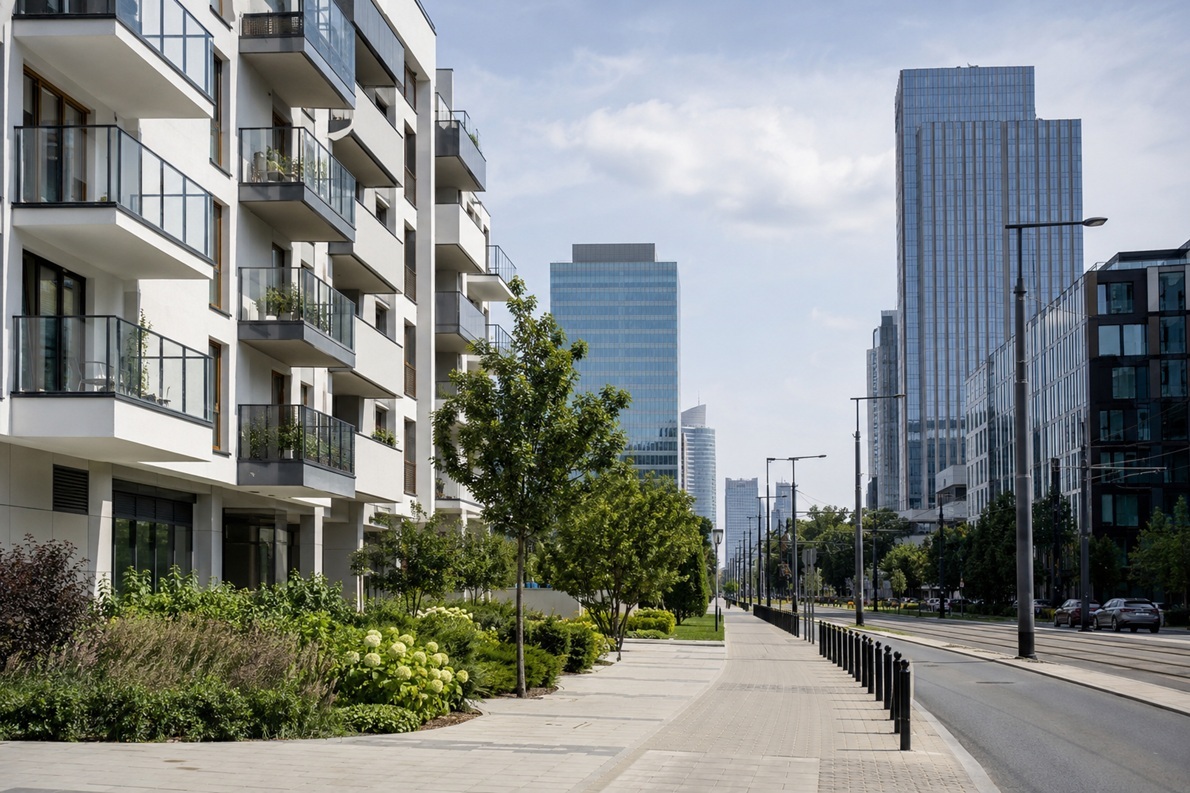
Modern Warsaw residential district near office buildings, suitable for corporate tenants

Warsaw remains the most expensive rental market in Poland by a clear margin — the citywide average total rent sat around 3,500–4,000 PLN in early 2026, well above Kraków, Wrocław or Gdańsk. That premium is a function of scale: Warsaw concentrates the largest share of Poland's corporate headquarters, international institutions, universities and government functions, which together sustain a tenant pool that is broader and more resilient than in any other Polish city.

After the sharp rent inflation of 2022–2023 driven partly by the arrival of refugees and a tight supply of available stock, the Warsaw rental market has spent 2025 and early 2026 in a period of relative stabilisation. Average asking rents were essentially flat into January 2026, with some segments even showing modest softening month-on-month — a sign of a market finding its level rather than one still overheating.

For owners, that stabilisation is a mixed signal but a healthy one. It means the aggressive rent growth of recent years is unlikely to repeat, but it also means current rent levels are more sustainable and less likely to correct sharply downward. Ongoing costs, particularly building service charges and energy, have continued to rise, which is an important distinction for owners modelling net rather than gross returns.

The practical implication for a foreign investor is that Warsaw rental income should be modelled on realistic, current asking-rent data by district and unit type — not on the sharper growth curves of 2022–2023 — while building in a clear-eyed view of rising non-rent running costs.

01 · Tenant depth

Poland's deepest corporate and student tenant pool

Warsaw hosts the largest concentration of corporate offices, embassies, universities and relocating professionals in Poland, giving owners a broader and more resilient base of demand than smaller markets.

02 · Price stabilisation

Rent growth has cooled from the 2022–2023 spike

After sharp increases driven by a supply-demand shock, Warsaw rents have stabilised through 2025 and into 2026 — a more predictable base for long-term income modelling.

03 · Simple tax regime

A flat, predictable rental tax structure

Private rental income is taxed under a straightforward flat-rate scheme with no complex deductions to manage — a genuine administrative advantage for foreign, non-resident owners.

Rent data

What Warsaw apartments actually rent for, by district

District and unit size are the two biggest drivers of monthly rent — often more decisive than the exact building or finish, and the reason per-m² rates and total rents don't always move together.

Rent per square metre varies meaningfully across Warsaw, and it is worth separating two different measures. On a per-m² basis, smaller central units in Mokotów and Śródmieście typically command the highest rates, often 85–95 PLN/m² for compact studios and one-bedrooms. On a total monthly rent basis, however, Wilanów and parts of Żoliborz can produce higher absolute rents than denser central districts, simply because the typical unit there is a larger, two- or three-bedroom family apartment rather than a studio. Śródmieście carries the highest absolute rents for larger, prestige units, because it is the district most closely associated with diplomatic and senior-executive tenants.

Mokotów ★
~85–95 PLN/m²
Typical unit: 1–2 bed · corporate tenants
Wilanów
~75–85 PLN/m²
Typical unit: 2–3 bed, larger · families, expats
Żoliborz
~75–85 PLN/m²
Typical unit: 2 bed · limited supply
Wola
~75–90 PLN/m²
Typical unit: studio/1 bed · Rondo Daszyńskiego
Unit type Typical size Indicative monthly rent Best-fit districts
Studio 24–35 m² 2,300 – 3,200 PLN Wola, Praga-Południe, Ochota
1-bedroom (2-room) 38–58 m² 3,000 – 4,500 PLN Mokotów, Wola, Śródmieście
2-bedroom (3-room) 58–80 m² 3,700 – 6,500 PLN Mokotów, Wilanów, Żoliborz
Prestige / large family unit 80–150 m² 7,000 – 13,000+ PLN Śródmieście, Wilanów
Reading the rent numbers correctly

Asking rent and achieved rent are not identical — expect a realistic gap of a few percent once negotiation and any vacancy between tenancies are factored in. A citywide per-m² average and a citywide average total rent are two different measures of the same market, not contradictory figures — always check which one a source is quoting before comparing it to another. District averages are also a starting point, not a ceiling or a floor. Primary sources for this section: NBP quarterly housing market report and current Otodom listing data for Warsaw.

Investment returns

Gross and net rental yields across Warsaw

Yield is a function of the relationship between purchase price and achievable rent — not of rent alone. Smaller units in mid-priced districts consistently outperform larger, prestige units on this measure.

Gross yield · studio, mid-tier district
6.0–7.0%
Wola, Praga-Południe, Ochota — highest ratios in the city
Gross yield · 1–2 bed, established district
5.0–6.0%
Mokotów, Żoliborz — balance of yield and tenant quality
Gross yield · prime district
4.5–5.5%
Śródmieście, Wilanów — capital preservation priced in

Net yield — what an owner actually keeps after vacancy, management, building service charges and maintenance — is typically 1.5–2 percentage points lower than the gross figure. NBP's own quarterly comparison of rental returns against deposit and bond yields confirms this general order of magnitude for Polish housing. A studio showing 6.5% gross in Wola will usually deliver closer to 4.5–5% net once these costs are accounted for. Owners who manage the property personally rather than through an agency can narrow that gap, at the cost of the time and local presence that active management requires — a common trade-off for non-resident owners.

Why smaller units in mid-tier districts often outperform

Smaller units carry a lower absolute purchase price relative to the rent they command, which mechanically produces a higher yield ratio — and they also tend to have shorter voids between tenants, since the pool of renters looking for a studio or one-bedroom is larger than the pool looking for a large family apartment. This is the core reason yield-focused investors in Warsaw gravitate toward Wola and Praga-Południe studios rather than Śródmieście prestige units.

Illustrative calculation

A worked example — Wola studio bought for rental income

Illustrative only, based on current market data. Every purchase should be modelled individually against its specific price and rent.

Investment example — Wola studio, 30 m²

Illustrative calculation based on Q1–Q2 2026 market data. For indicative purposes only.

Purchase price (30 m² · secondary market, Wola) 540,000 PLN
Additional purchase costs (PCC 2% + notary + agent) ~32,000 PLN
Total capital deployed ~572,000 PLN
Monthly gross rent (furnished, standard finish) 2,700 PLN
Annual gross rental income 32,400 PLN
Vacancy + management + maintenance (~15%) – 4,860 PLN
Rental tax — ryczałt 8.5% on net rental receipts – 2,754 PLN
Net annual income (after tax) ~24,800 PLN
Net yield on total capital deployed ~4.3–4.6%
Why the net figure is lower than the headline yield

The gross yield on this unit before costs and tax is exactly 6.0% (32,400 PLN ÷ 540,000 PLN), squarely in line with Wola studio averages. The gap between that headline number and the ~4.3–4.6% net figure above is exactly why owners should always model income after vacancy, running costs and tax — not just the advertised gross yield used in marketing materials across the market.

Taxation

How rental income is taxed in Poland

Private rental income is taxed under a simple flat-rate scheme (ryczałt) — one of the more straightforward tax regimes for landlords anywhere in Europe.

Calculator, lease agreement and financial documents on a desk for rental tax settlement

Since 2023, private individuals renting out property outside a registered business in Poland must use the flat-rate scheme known as ryczałt od przychodów ewidencjonowanych, set out in the Ustawa o zryczałtowanym podatku dochodowym, Art. 12 — there is no longer an option to be taxed on the progressive scale for this type of income, and this remains unchanged in 2026. The structure is simple: 8.5% is charged on annual rental income up to 100,000 PLN, and 12.5% applies to the portion above that threshold. Crucially, the tax is calculated on gross rental revenue, not on profit — costs such as renovation, mortgage interest, agency commission or furnishing cannot be deducted from the taxable amount. Official plain-language guidance is also published on podatki.gov.pl.

Ryczałt — annual rent of 32,400 PLN
Applicable rate 8.5% (below 100,000 PLN)
Tax due 2,754 PLN
Filing Monthly or quarterly payment + annual PIT-28
Effective tax rate 8.5% flat
Ryczałt — annual rent of 130,000 PLN (portfolio)
First 100,000 PLN 8,500 PLN (8.5%)
Remaining 30,000 PLN 3,750 PLN (12.5%)
Total tax due 12,250 PLN
Effective tax rate ~9.4%
Married owners

A joint declaration can double the lower-rate threshold

Married couples with joint property ownership may file a declaration to have all rental income taxed on one spouse's return, raising the 8.5% threshold to 200,000 PLN combined — useful for owners with more than one rental unit.

No ZUS contribution

Private rental does not trigger social security

Private rental income taxed under ryczałt, outside a registered business, does not require ZUS social security or health-insurance contributions in 2026 — a meaningful administrative simplification compared to running a formal letting business.

Filing obligation

Annual PIT-28 return required

Owners pay tax monthly or quarterly and confirm the total in an annual PIT-28 declaration, due by 30 April of the year following the tax year (PIT-28 for 2026 is due by 30 April 2027). Foreign owners who are Polish tax residents are subject to the same filing rules.

Tax residency and cross-border situations

Whether a foreign owner is taxed in Poland, in their home country, or in both — with credit given for tax paid abroad — depends on their personal tax residency status and any applicable double-taxation treaty. This is a matter for individual professional advice and is not covered generically by this guide; we coordinate qualified local tax advisors as part of our service for foreign owners. Official guidance: podatki.gov.pl — rental income (ryczałt).

Demand drivers

Who actually rents in Warsaw — and what that means for owners

Matching the unit to the right tenant profile is often a bigger driver of realised return than the district alone.

Corporate and relocation tenants

  • concentrated in Mokotów, Wola and Śródmieście, near major office clusters
  • typically seek furnished 1–2 bedroom units with reliable building management
  • longer average tenancies and lower turnover than the student segment
  • often relocated through corporate housing budgets, reducing payment risk

Students and young professionals

  • drive strong demand for studios and small 1-bedroom units near universities
  • concentrated around Ochota, Śródmieście and well-connected transit corridors
  • higher turnover but larger overall tenant pool, reducing vacancy risk
  • typically the segment achieving the highest gross yield per m²
Diplomatic and senior-executive tenants

Śródmieście and, to a lesser extent, Wilanów host the tenant pool most likely to include diplomats and senior corporate leadership — tenants who prioritise address and building quality over rent optimisation, and who typically sign longer, more stable leases. This segment supports Warsaw's lowest vacancy rates but also its lowest yield ratios, since the underlying purchase price is priced for exactly this quality of demand.

Ongoing costs

What it costs to keep a Warsaw rental running

Rent is only half the picture. Building service charges and rising energy costs increasingly determine the real margin an owner keeps.

Every apartment in a Warsaw cooperative or condominium building carries a monthly czynsz administracyjny — a building service charge covering shared maintenance, the building's reserve fund, and often heating and water. In 2026 this typically runs 12–18 PLN/m² in standard stock (600–900 PLN/month for a 50 m² unit), rising to 18–22 PLN/m² in newer buildings with concierge, underground parking ventilation or landscaped grounds, and this cost is usually the landlord's responsibility unless explicitly passed through to the tenant in the lease. According to GUS consumer price data, costs in the "housing, water, electricity, gas and other fuels" category were running roughly 4–5% higher year-on-year through the first half of 2026 — consistently faster than headline rent growth in the current cycle, so this line item deserves close attention when modelling net returns.

Build the service charge into the lease structure

Most Warsaw leases separate base rent (czynsz najmu, the owner's income) from the building service charge and utilities, which are passed through to the tenant as a fixed or metered advance payment. Structuring this correctly protects the owner from rising building costs eroding net income.

Budget realistically for vacancy between tenancies

Even in strong districts, a realistic allowance of 5–10% of the year as void time between tenancies (viewings, minor refresh, contract turnaround) should be built into any net yield calculation rather than assuming continuous, uninterrupted occupancy.

Furnishing and finish level affect both rent and tenant quality

Fully furnished, well-presented units consistently rent faster and to a more reliable tenant profile in Warsaw's mid-market segment, particularly for the corporate and relocation tenant pool. The upfront furnishing cost is not deductible against ryczałt tax, which makes getting the finish and furnishing level right the first time — rather than upgrading later — the more tax-efficient approach.

Due diligence

What to watch before buying for rental income

The biggest gap between projected and realised yield usually comes from a handful of predictable, avoidable mistakes.

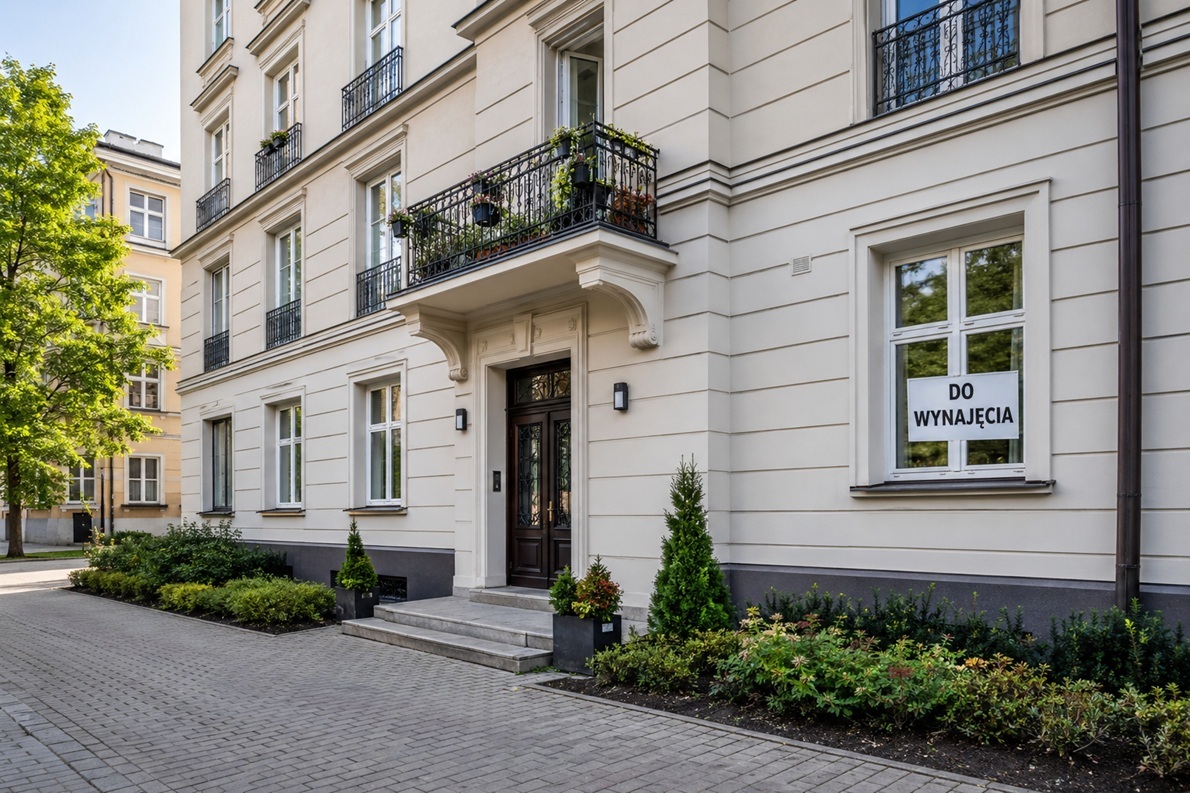
Residential building facade in Warsaw with a visible for-rent sign in a window

Don't model on gross yield alone

Marketing materials across the market frequently quote headline gross yield. Always recalculate net of vacancy, building service charges, management and the 8.5–12.5% rental tax before comparing properties — the ranking of "best" districts can change once this is done properly.

Check the building's service charge and reserve fund

A low advertised czynsz administracyjny sometimes signals an underfunded building reserve — which can mean a large one-off special assessment for major repairs later. Ask for the building's recent annual meeting minutes and reserve fund balance before purchase.

Match unit size to the tenant pool you actually want

Larger units have a smaller pool of renters and longer typical vacancy between tenancies. If yield and low vacancy are the priority, a well-located studio or one-bedroom usually outperforms a larger unit purchased on the assumption that "bigger rents for more."

Confirm the lease structure before signing

Poland offers both standard leases and the more landlord-protective najem okazjonalny (occasional tenancy), which requires a notarised tenant declaration on eviction. For owners concerned about non-paying tenants, using najem okazjonalny is worth discussing with a local lawyer at lease-drafting stage.

Track the 100,000 PLN tax threshold across all properties

The ryczałt threshold applies to an owner's total rental income across every property they own, not per unit. Owners with more than one Warsaw rental should track combined income carefully to anticipate when the 12.5% rate begins to apply.

Verify short-term rental rules before assuming that model

Short-term and Airbnb-style letting is subject to a different regulatory and tax treatment than standard long-term rental, and building-level rules (condominium resolutions) can restrict it entirely. Confirm both before basing a purchase decision on a short-term rental strategy.

Owner advisory

How Warsaw Investor Care helps foreign owners maximise rental income

Our role is to help you buy the property that fits the tenant pool and yield profile you actually want — and keep it performing after the sale closes.

Before any property is shown, we build a realistic income model based on current district-level rent and yield data — not the optimistic gross figures often used in marketing. That means clarifying, upfront, whether the priority is maximum yield, tenant quality and low vacancy, or long-term capital preservation, and identifying which Warsaw districts and unit types genuinely match that priority.

We coordinate the full path from purchase to income: property sourcing and negotiation, legal and tax coordination including introductions to qualified Polish tax advisors for the ryczałt filing and any cross-border tax questions, and where useful, renovation and finishing to the specification that performs best with the target tenant profile.

For owners who want a fully hands-off structure, we can also coordinate rental management — tenant sourcing, lease drafting (including najem okazjonalny where appropriate), rent collection and building-relationship management — so that owners based outside Poland are not managing multiple local parties independently.

The goal is a property that performs as modelled: a realistic yield, a tenant profile that matches the unit, and a running-cost picture the owner understood clearly before committing capital.

01

Yield and tenant-profile clarification

We establish whether the priority is maximum yield, tenant stability, or capital preservation, and translate that into a target district and unit-size shortlist.

02

Property sourcing with a realistic net-yield model

Every shortlisted property is evaluated with a full net yield calculation — including building service charges, realistic vacancy and rental tax — before it is presented.

03

Building and reserve-fund due diligence

We check service charge levels, reserve fund health and any planned special assessments before purchase, to avoid unpleasant surprises after closing.

04

Legal, tax and lease-structure coordination

We coordinate lawyers and tax advisors for the purchase, the ryczałt registration and filing, and the correct lease structure for the target tenant profile.

05

Renovation and furnishing to a rental-ready standard

Where finishing or furnishing is required, we coordinate it to the specification that performs best with the intended tenant pool — see our renovation and finishing service.

06

Ongoing rental management, if required

For owners who want a fully hands-off structure, we can manage tenant sourcing, leasing and rent collection, keeping the property performing without requiring the owner's local presence.

FAQ

Frequently asked questions about rental income in Warsaw

The questions foreign owners ask most often — answered directly with current data and practical advisory context.

What rental yield can I expect from a Warsaw apartment in 2026?

Gross rental yields in Warsaw typically range from 4.5% to 7% depending on district and unit type. Small studios in Wola, Praga-Południe and Ochota achieve the highest ratios, often 6–7% gross, while prime Śródmieście and Wilanów addresses sit closer to 4.5–5.5% gross. Net yield after vacancy, building charges, management and tax is typically 1.5–2 percentage points lower than the gross figure.

Why do I see different figures for "average rent in Warsaw"?

Because "average rent" can mean two different things: rent per square metre (which tends to be highest for small studios) or average total monthly rent across all listed units (which is pulled up by larger family apartments). A studio can have the highest PLN/m² rate in the city while still producing a lower total monthly rent than a three-bedroom flat with a lower PLN/m² rate. Always check which measure a figure refers to before comparing sources.

How is rental income taxed in Poland in 2026?

Private rental income is taxed under a flat-rate scheme (ryczałt): 8.5% on annual rental income up to 100,000 PLN, and 12.5% on the portion above that threshold. Tax is calculated on gross rental revenue — costs such as renovation, agency fees or mortgage interest cannot be deducted. Owners file an annual PIT-28 return, due by 30 April of the following year.

Which Warsaw district gives the best rental income?

Wola and Mokotów generally offer the strongest combination of rental demand and yield, driven by proximity to major office clusters. Praga-Południe and parts of Wola offer higher gross yields on lower entry prices, while Śródmieście and Wilanów trade lower yield for stronger long-term capital preservation and a more resilient international tenant pool. The right answer depends on whether the buyer prioritises yield or capital preservation.

Do foreign owners need a Polish company to rent out property?

No. Private individuals, including foreign owners, can rent out a Warsaw apartment directly under the ryczałt scheme without registering a business. A company structure may make sense for owners with a larger portfolio or specific tax planning needs, but it is not a requirement to legally rent out one or two apartments.

What ongoing costs reduce net rental income in Warsaw?

The main ongoing cost is the building service charge (czynsz administracyjny), typically 12–18 PLN/m² per month in standard buildings and up to 18–22 PLN/m² in newer developments, plus realistic vacancy between tenancies, any management fees, and the 8.5–12.5% rental tax. Building service charges and utility costs have risen faster than rents recently, so this line item deserves careful attention when modelling net returns.

Is short-term rental (Airbnb-style) a good strategy in Warsaw?

It can work in the right building and location, but it is subject to a different regulatory and tax treatment than standard long-term rental, and many condominiums restrict or prohibit it through building-level resolutions. Confirm both the building's rules and the applicable tax treatment with a local advisor before basing a purchase decision on a short-term rental model.

How much rent can a studio in Wola realistically achieve?

A well-located, well-presented studio (24–35 m²) in Wola typically achieves 2,300–3,200 PLN per month in the current market, depending on exact location, floor and finish. This segment tends to have the shortest vacancy periods of any unit type in Warsaw due to strong, consistent demand from young professionals and students.

Next step

Considering Warsaw for rental income?

The right purchase for rental income requires the right district, the right unit size, and an honest net yield model before you commit capital. We help with all three.

Key handover and handshake after signing a rental agreement in a modern Warsaw apartment

Let's build a realistic rental income model for your budget.

If you are considering Warsaw for rental income, we can help you compare districts and unit types, build an honest net yield model, coordinate tax and legal advice, and manage everything from sourcing through to rental activation. No charge for an initial consultation.

Yield modelling & sourcing
Tax & legal coordination
Renovation & furnishing
Rental management
Off-market access

Continue reading — guides & district profiles

District guide

Mokotów Property Guide

Warsaw's top residential district for balanced yield and tenant quality — the strongest all-round rental case in the city.

District guide

Wola Property Guide

Modern stock and the highest-yield case among Warsaw's central districts — the natural fit for yield-focused buyers.

Legal guide

Can Foreigners Buy in Poland?

Permits, process, notarial deed and non-EU buyer rules — everything needed before beginning a search.

Cost guide

Taxes and Fees When Buying

PCC tax, notary fees and acquisition costs — the purchase-side complement to this rental income guide.

Service

Legal Coordination Service

Transaction structure, notarial coordination and tax advisor introductions for foreign buyers in Warsaw.

Service

Renovation & Finishing

Rental-ready renovation and furnishing coordination — from scope to handover-ready, tenant-ready finish.

© 2026 Warsaw Investor Care. All rights reserved.

This page is for informational and marketing purposes only. Every market and tax figure above is sourced and linked directly at the point it is used — primarily the National Bank of Poland (NBP), Statistics Poland (GUS), Otodom listing data, and the official text of Poland's rental tax legislation. Data point updated: July 2026. All rents, yields, costs, tax figures and projections are indicative and may not reflect any specific property or transaction. This content does not constitute legal, tax, investment or financial advice. Always verify all information relevant to a specific purchase or rental strategy with independent legal, tax and financial advisors before proceeding.