
Warsaw Investor Care logo
Financing guide · Poland · Updated July 2026

Mortgage in Poland
for foreign buyers.

A complete guide to obtaining a Polish mortgage (kredyt hipoteczny) as a foreign national — eligibility criteria, required documentation, the application process, current interest rates and the key differences between EU and non-EU borrowers.

Covers: Eligibility · WIBOR/POLSTR · LTV · zdolność kredytowa · documentation · application process · costs Also read: Buying process · Taxes & fees · New build vs resale

Polish banks do lend to foreign nationals — including non-EU buyers — but the process is more demanding than a domestic mortgage application, the documentation requirements are more extensive, and the number of banks actively willing to lend to non-residents is significantly narrower than the full Polish banking market. Foreign buyers who approach Polish mortgage applications without preparation consistently face delays, rejections and failed transactions. Those who approach with the right documentation structure, an accurate understanding of their zdolność kredytowa (creditworthiness) and a realistic timeline succeed with the same lenders.

This guide covers the complete picture: who can borrow, what rates apply, what banks look for, what documentation is required, how the application process works and what the true cost of Polish mortgage financing is — including all fees, insurance and the ongoing WIBOR/POLSTR-linked rate exposure that determines the real monthly payment over the loan term.

Reference rate (NBP)
3.75%
NBP reference rate, unchanged since 5 March 2026 and confirmed by the 8 July 2026 MPC decision — source: NBP
Typical mortgage rate
WIBOR 3M + 1.5–2.5%
Total rate approx. 5.6–6.1% on standard foreign buyer loans as of early July 2026
Minimum own contribution
20–30%
Non-residents typically required to provide 30% down — higher than domestic standard
Maximum loan term
25–35 years
Standard Polish mortgage terms — shorter terms for older borrowers per KNF guidelines
Eligibility by nationality

Can foreign nationals get a mortgage in Poland?

The answer is yes — but with significant variation in how accessible Polish mortgage financing is depending on the buyer's nationality, residency status and income source.

Warsaw skyline at golden hour — Palace of Culture and modern towers in Poland's primary mortgage and property investment market Warsaw — foreign buyer mortgage financing is available from multiple Polish banks under defined conditions
EU / EEA citizens

Broadest access — treated near-equivalently to Polish nationals

EU and EEA citizens with documented income from a Polish employer or Polish business activity have access to the full range of Polish mortgage products at standard rates. EU citizens with foreign income face more scrutiny but are generally accepted by most major Polish banks — PKO BP, Pekao, mBank, ING, Santander — with appropriate income documentation. Down payment: typically 20% (standard KNF minimum).

Non-EU residents in Poland

Accessible with Polish income and valid residence permit

Non-EU nationals legally residing in Poland (karta pobytu) with documented Polish-source income — employment contract, business income, rental income from Polish property — can access Polish mortgages from a narrower but still viable set of lenders. Required: valid residence permit with sufficient remaining validity, typically minimum 12 months beyond the intended loan term. Down payment: typically 25–30%.

Non-EU non-residents

Possible but significantly restricted — specialist lenders only

Foreign nationals without Polish residency or Polish-source income face the highest barriers. A small number of Polish banks — and specialist mortgage brokers with access to non-standard credit committees — will consider non-resident applications from buyers in stable high-income jurisdictions (UK, UAE, US, Israel, Switzerland). Down payment: typically 30–40%. Income documentation requirements are extensive and foreign credit history is reviewed on a case-by-case basis.

Important — Polish mortgage market for non-residents has narrowed since 2022

Several major Polish banks that previously served non-resident foreign buyers have tightened their lending criteria or ceased non-resident programmes following 2022 regulatory and risk management changes. The available lender pool for non-EU non-residents is genuinely narrower in 2026 than it was in 2019–2021. Foreign buyers planning to use Polish mortgage financing should engage a qualified Polish mortgage broker (doradca kredytowy) with specific non-resident experience before making any property commitment that depends on financing availability.


Rate structure

Polish mortgage interest rates — WIBOR, POLSTR and what foreign buyers actually pay

Polish mortgage rates are predominantly variable and linked to WIBOR — the Warsaw Interbank Offered Rate. Understanding this structure, and the ongoing reform that will eventually replace it, is essential before modelling the true cost of Polish mortgage financing.

Financial calculator and affordability analysis — modelling monthly mortgage instalments for foreign buyers in Poland Rate modelling and affordability analysis — the foundation of any financing decision

WIBOR-linked variable rates. The majority of Polish mortgages are still priced as WIBOR 3M or WIBOR 6M plus a bank margin (marża). WIBOR 3M stood at approximately 3.85% in early July 2026, tracking the NBP reference rate of 3.75%, which has been held unchanged since the March 2026 cut and was reconfirmed at the Rate-Setting Council's 8 July 2026 meeting. At a typical bank margin of 1.8–2.2% for foreign buyers, the total mortgage rate is approximately 5.6–6.1% on a standard variable-rate loan — a meaningfully lower cost of borrowing than in 2023–2024, when NBP rates were far higher. This rate adjusts every 3 or 6 months as WIBOR changes — buyers are fully exposed to future rate movements in either direction, and further NBP cuts are not expected before 2027 based on current analyst consensus.

Fixed-rate periods. Some Polish banks offer mortgages with a fixed rate period (okres stałego oprocentowania) of 5 years under the Rekomendacja S framework introduced by KNF (Komisja Nadzoru Finansowego). During this period, the rate does not change regardless of WIBOR movements. After the fixed period expires, the loan reverts to WIBOR (or its successor benchmark, see below) plus margin. Fixed-rate periods are typically priced at a modest premium to current variable rates. For foreign buyers uncertain about medium-term rate direction, a 5-year fixed period provides payment certainty at a modest cost premium.

WIBOR to POLSTR transition — and the timeline has just been formalised. Poland's reference-rate reform selected POLSTR (Polish Short Term Rate) — not WIRON — as the designated successor to WIBOR; WIRON was dropped by the steering committee of the National Working Group on benchmark reform back in 2024. GPW Benchmark, the official administrator of both indices, has published POLSTR since 2 June 2025. In May 2026, GPW Benchmark and KNF jointly announced the wind-down schedule for WIBOR/WIBID: banks and other supervised lenders are expected to stop writing new WIBOR-linked contracts by 31 December 2026, so new mortgage applications from 2027 onward should increasingly be quoted on POLSTR. Existing WIBOR-based mortgages are unaffected in the near term — the benchmark will continue to be published and can remain in force in existing contracts until 31 December 2036, with formal wind-down completing 1 January 2037. No statutory replacement rate is being imposed for existing contracts, since regulators judged the ten-year runway sufficient for the market to transition on its own. Foreign buyers signing a new mortgage from 2027 should confirm with their broker whether the product they are offered is priced on WIBOR (for a limited remaining window) or POLSTR, since POLSTR is a backward-looking overnight-transaction rate rather than WIBOR's forward-looking, panel-based structure, and the two can diverge by several tenths of a percentage point in either direction depending on the rate environment.

Foreign currency mortgages — no longer available. Polish banks stopped offering CHF and EUR mortgage products to retail borrowers following the Swiss franc crisis of 2015 and subsequent KNF regulatory restrictions. All new Polish residential mortgages are denominated in PLN. This eliminates currency risk for buyers — the mortgage currency matches the property's PLN value — but means buyers with foreign-currency income must convert to PLN to service the loan, creating ongoing exchange rate exposure on debt repayments.

Monthly payment example at current rates

Mortgage of 600,000 PLN over 25 years at 5.8% total rate (WIBOR 3M ~3.85% + margin ~1.95%): monthly instalment approximately 3,790 PLN (equal instalments — raty równe). Total interest cost over 25 years at this rate: approximately 538,000 PLN. Rate movements of ±1% change the monthly payment by approximately ±360 PLN on this loan size.

Creditworthiness

Eligibility criteria — what Polish banks assess for foreign buyer mortgage applications

Polish banks assess mortgage applications under the KNF Rekomendacja S framework. Understanding what banks look for — and where foreign applications typically face scrutiny — is what allows buyers to prepare properly.

Polish mortgage agreement — umowa kredytu hipotecznego documentation for foreign property buyers in Warsaw
Property keys on mortgage signing documents — completing a home purchase with a Polish mortgage loan
Assessment criterion What banks evaluate Foreign buyer specific consideration
Zdolność kredytowa (creditworthiness) Monthly net income versus total debt service obligations — the DTI (debt-to-income) ratio must meet bank-specific thresholds, typically maximum 40–50% of net income to all debt payments Foreign income is assessed with a haircut by most banks — typically 80–90% of documented foreign income is recognised, reducing calculated creditworthiness versus equivalent Polish income
Income stability and type Employment contract (umowa o pracę) preferred; self-employment, B2B contracts and business income accepted with longer documentation period (typically 24 months) Foreign employment contracts require certified translation; foreign business income requires 2 years of tax returns from the relevant jurisdiction plus Polish accountant verification
Credit history Polish BIK (Biuro Informacji Kredytowej) credit register checked — shows all Polish credit obligations. Foreign credit history checked via available international exchanges Buyers with no Polish credit history start with a neutral BIK profile — no negative marks, but also no positive history. Some banks require minimum Polish banking relationship period (3–12 months)
Own contribution (wkład własny) KNF Rekomendacja S requires minimum 20% own contribution for standard loans; 10% permitted with additional insurance (ubezpieczenie niskiego wkładu własnego) Non-resident foreign buyers are typically required to provide 25–30% own contribution — banks apply higher LTV caution on non-resident applications regardless of income level
Residency and legal status Permanent or temporary residence permit reviewed — banks assess the likelihood of the borrower remaining in Poland or maintaining Polish commitments over the loan term Non-resident buyers without Polish ties face the highest scrutiny — banks assess whether the buyer has sufficient connection to Poland to service and maintain the loan relationship over decades
Property type and location Residential apartments in major cities — Warsaw, Kraków, Wrocław, Gdańsk, Poznań — are the most accepted collateral. Rural land, commercial property and atypical residential stock are more restricted Warsaw apartments — the most common purchase for foreign investors — are accepted as collateral by all Polish mortgage lenders. No additional restriction for foreign buyers on standard Warsaw residential property
Document requirements

Documentation required for a Polish mortgage application as a foreign buyer

Polish mortgage documentation requirements for foreign nationals are more extensive than for domestic applicants. Preparing documents in advance — before engaging a bank — eliminates the most common source of application delay.

Signing a Polish mortgage and property document — notary stamp and legal deed documentation for foreign buyers Mortgage documentation — preparation is the single most effective way to reduce application timeline

Personal identification documents

  • Valid passport — all pages, including entry/exit stamps (some banks require this)
  • Residence permit (karta pobytu) if applicable — both sides, with expiry date clearly visible
  • PESEL number — Polish personal identification number; required by all banks; obtained from the relevant district office (urząd gminy) or at passport control on entry for stays over 30 days
  • NIP (tax identification number) if registered for Polish tax purposes
  • Marriage certificate with certified Polish translation if applying jointly — apostilled if issued outside Poland

Income documentation — employed

  • Employment contract (umowa o pracę) — certified translation if in a foreign language; minimum 3 months' employment history at current employer for most banks, 6–12 months preferred
  • Last 3–6 months' payslips — certified translation if foreign language
  • Last 3–6 months' bank statements showing salary credits
  • Employer confirmation letter (zaświadczenie o zatrudnieniu) — on company letterhead, confirming position, salary and employment period
  • For foreign employment: evidence the income is received in a stable currency and can be serviced regardless of the buyer's physical location

Income documentation — self-employed / business

  • Last 2 years' tax returns from the relevant jurisdiction — certified translation required; apostille may be required depending on country of issue
  • Last 2 years' business financial statements (P&L and balance sheet) — certified translation
  • Business registration documents — certified translation
  • Last 6–12 months' business bank statements
  • Polish accountant's verification letter for complex income structures — recommended for non-standard cases

Property documentation

  • For new-build: developer agreement (umowa deweloperska) or reservation agreement; building permit; developer's land register extract
  • For resale: land register extract (odpis z KW) — obtained from ekw.ms.gov.pl; property valuation (operat szacunkowy) commissioned by the bank's approved appraiser
  • Floor plan (rzut lokalu) with area specification
  • Preliminary purchase agreement (umowa przedwstępna) if signed — or LOI confirming purchase intent
  • Evidence of own contribution funds — bank statements showing the down payment capital has been held for at least 3 months (anti-money-laundering requirement)
Translation and apostille — the most common delay factor

Foreign-language documents submitted to Polish banks must be translated by a Polish sworn translator (tłumacz przysięgły). Documents issued outside Poland may require apostille under the Hague Convention before they are accepted. Typical turnaround: sworn translation 3–7 business days; apostille 1–4 weeks depending on the issuing country. Build this into your mortgage application timeline — it cannot be accelerated by the bank and is the single most common cause of application delays for foreign buyers.

Application timeline

The Polish mortgage application process — stages and realistic timeline for foreign buyers

A well-prepared foreign buyer mortgage application takes 6–10 weeks from initial submission to mortgage offer. Unprepared applications routinely take 3–5 months or fail entirely.

01

Pre-application — broker selection and creditworthiness assessment

Engage a Polish mortgage broker (doradca kredytowy) with documented non-resident experience before approaching any bank directly. The broker maps which lenders are currently accepting applications from buyers with your specific nationality, residency status and income type — saving weeks of misdirected direct bank approaches. A preliminary creditworthiness assessment (wstępna ocena zdolności kredytowej) establishes the realistic loan amount before any property commitment.

02

Document preparation — 2–4 weeks

Compile all required documents (see §4 above). Commission sworn translations of foreign-language documents. Obtain apostilles where required. Prepare 3–6 months of bank statements showing the down payment capital. Open a Polish bank account if not already held — most lenders require or strongly prefer an existing Polish banking relationship. This stage cannot be compressed — it determines the quality of the application package.

03

Formal application submission — simultaneous to 2–3 banks

Submit a complete application package to 2–3 banks simultaneously through the broker. Do not apply sequentially — each rejection extends the timeline and multiple BIK enquiries within 30 days are treated as a single enquiry under Polish credit bureau rules, so parallel applications do not compound credit risk. The broker manages the submission to each lender's specific format requirements.

04

Bank credit analysis — 2–4 weeks

The bank's credit committee reviews the application, checks BIK and any available foreign credit data, and commissions a property appraisal (operat szacunkowy) from an approved appraiser at the buyer's cost (typically 500–800 PLN). The bank may request additional documents during this period — respond promptly as delays at this stage extend the overall timeline. Non-resident applications typically take longer to process than domestic ones due to the additional verification requirements.

05

Mortgage offer (decyzja kredytowa) — review before accepting

The bank issues a formal mortgage decision (decyzja kredytowa) specifying the approved loan amount, interest rate, margin, term, required own contribution, mandatory insurance requirements and all conditions of disbursement. Review this document with the broker and legal counsel before accepting — conditions attached to disbursement (e.g. provision of additional documentation, insurance policies to be taken out) must be completable before the property transaction deadline.

06

Mortgage agreement signing and disbursement

The mortgage agreement (umowa kredytu hipotecznego) is signed before the bank. The mortgage is registered in the land register Section IV simultaneously with or shortly after the property transfer deed — the notary handles this filing. Disbursement of the loan to the seller (or developer's escrow account for new-build) occurs per the agreed schedule — typically within 2–5 business days of transfer deed signing for resale; in tranches linked to construction milestones for new-build.

True cost of financing

Mortgage costs in Poland — all fees, insurance and RRSO calculation

The headline mortgage rate is not the true cost of borrowing. Polish mortgages carry mandatory and discretionary additional costs that materially affect the RRSO (Rzeczywista Roczna Stopa Oprocentowania — Annual Percentage Rate).

Cost component Typical amount / rate Mandatory? Notes
Mortgage arrangement fee (prowizja) 0–2% of loan amount — many banks waive with cross-sell products Varies by bank On 600,000 PLN loan: 0–12,000 PLN. Compare RRSO not just arrangement fee — waived fee often offset by higher margin
Property appraisal (operat szacunkowy) 500–800 PLN Yes — all banks Commissioned by bank from approved appraiser at buyer's expense. Non-refundable if application is unsuccessful
Mortgage insurance — bridging (ubezpieczenie pomostowe) 0.1–0.2% of outstanding loan per month Yes — until mortgage registered in KW Applies from disbursement until land register Section IV confirms mortgage registration — typically 1–3 months. On 600,000 PLN: 600–1,200 PLN/month during bridging period
Low down payment insurance (ubezpieczenie niskiego wkładu własnego) Varies — typically added to margin or charged as annual premium If LTV above 80% Foreign buyers at 70–80% LTV may face this requirement depending on the bank. Ceases once outstanding balance drops below 80% LTV threshold
Life insurance (ubezpieczenie na życie) 0.03–0.08% of outstanding loan per month Required by most banks as condition of loan Can be provided through bank's partner insurer (often at higher cost) or buyer's own policy (requires bank acceptance). On 600,000 PLN: 180–480 PLN/month
Property insurance (ubezpieczenie nieruchomości) 0.1–0.2% of property value per year Yes — all banks Must name the bank as beneficiary (cesja). Can be purchased through any authorised insurer — bank's own insurer typically more expensive. On 900,000 PLN property: 900–1,800 PLN/year
Land register mortgage entry fee 200 PLN Yes Fixed court fee for Section IV mortgage entry — collected by notary at mortgage agreement signing
Notary fee for mortgage agreement Per statutory scale — typically 500–2,000 PLN + 23% VAT Yes Separate from the property transfer deed notary fee — a second notarial act if mortgage signed separately from transfer
RRSO — the correct rate to compare between banks

Under Polish consumer credit law (Ustawa o kredycie hipotecznym z 2017 r.), banks must disclose the RRSO (Annual Percentage Rate) which includes the interest rate, arrangement fee, mandatory insurance and all recurring costs. Always compare RRSO between competing offers — not just the headline interest rate. A loan with a lower margin but mandatory bank insurance at above-market cost can have a higher RRSO than a loan with a slightly higher margin and no required insurance cross-sell.

Financing decision

Cash versus mortgage — when Polish financing makes sense for foreign investors

For many foreign buyers, the choice between cash purchase and Polish mortgage financing is not simply a question of availability — it is a capital allocation decision that depends on the investor's alternative use of funds and return expectations.

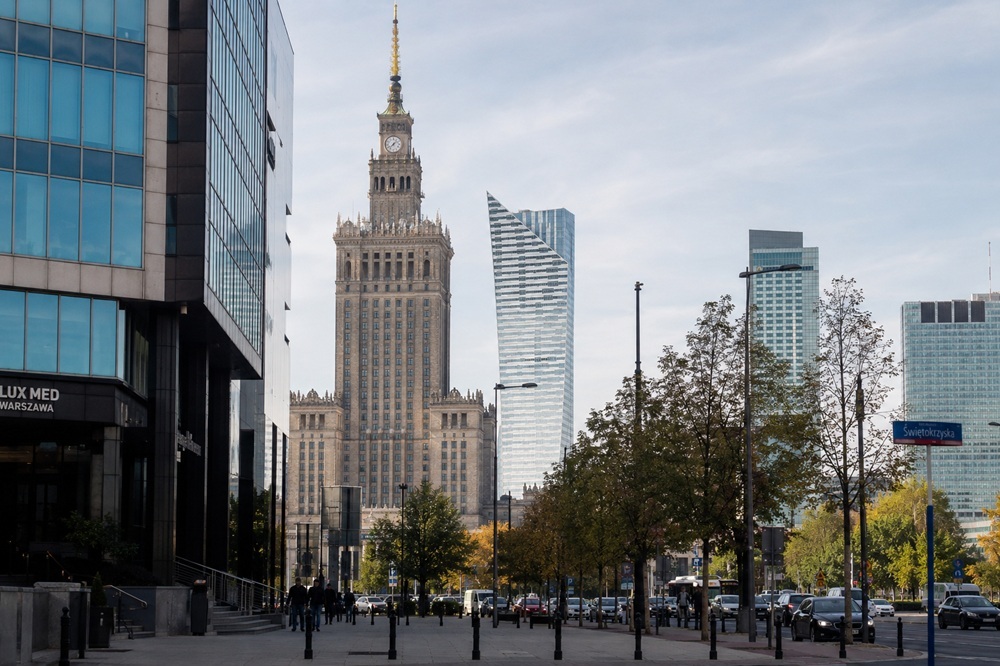
Warsaw city centre street level — Świętokrzyska street with Palace of Culture and financial district towers
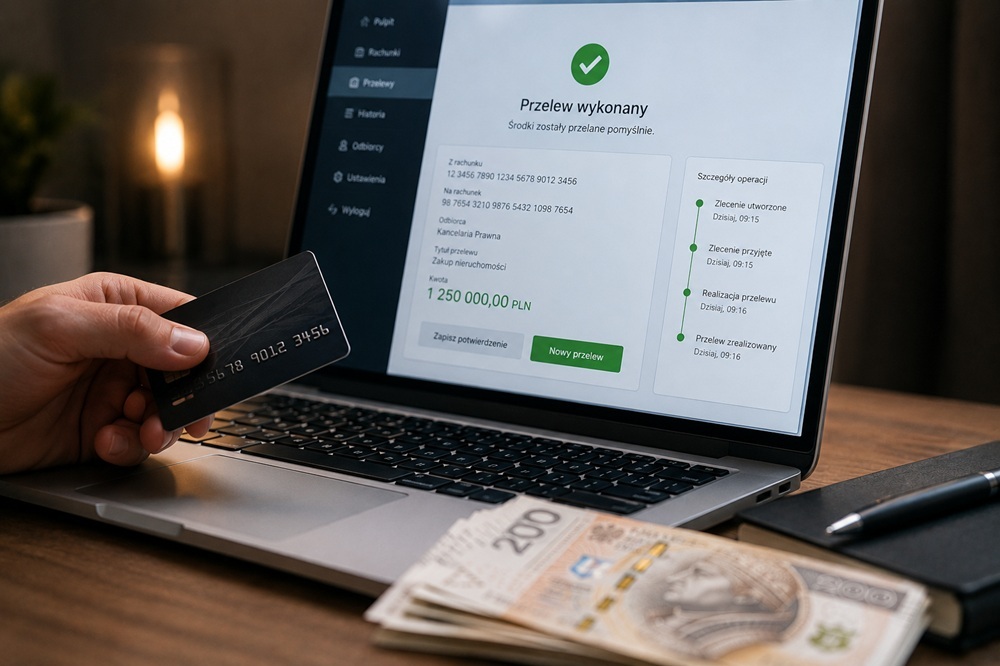
Bank transfer confirmation for a Warsaw property purchase — capital allocation for a cash property transaction

Arguments for Polish mortgage financing

  • At current rates (~5.6–6.1% total cost), leverage no longer requires strong capital appreciation to work — the carry gap against typical Warsaw gross yields (~5.0–6.0%) is close to breakeven, a substantially better starting point than in 2023–2024 when total borrowing costs regularly exceeded 8%
  • Capital preservation — using mortgage financing allows the buyer to retain liquid capital in higher-yielding or more liquid assets rather than concentrating it in a single illiquid property position
  • PLN-denominated debt on a PLN-valued asset creates a natural hedge against PLN appreciation — if PLN strengthens against the buyer's home currency, the mortgage liability grows in home currency terms but so does the asset value
  • For buyers with Polish residency and Polish-source income, mortgage interest was partially deductible under specific conditions (consult a Polish tax adviser for current rules)

Arguments for cash purchase

  • Even at today's lower rates, a leveraged purchase still carries interest-rate and refinancing risk over a 25–35 year term, including the risk that a future mortgage requires repricing onto POLSTR once WIBOR-linked products are phased out for new lending from 2027
  • Cash buyers face no creditworthiness scrutiny, no documentation burden and no application timeline risk — the transaction proceeds at the speed of legal due diligence only
  • Cash buyers are significantly more attractive to sellers and developers — stronger negotiating position, faster closing, no financing contingency risk
  • Non-resident foreign buyers face the most restrictive mortgage access — cash purchase eliminates the risk of a failed financing that collapses a property transaction after a deposit has been paid
  • No exposure to Polish banking relationship complexity, insurance cross-sell requirements or ongoing lender-bank relationship management
The key calculation at current rates

At approximately 5.6–6.1% total mortgage cost and 5.0–6.0% gross Warsaw residential yield, a leveraged Warsaw purchase in mid-2026 generates a carry (yield minus financing cost) of roughly –1.1% to +0.4% per year on the mortgaged portion — close to breakeven, and a substantial improvement versus 2023–2024 when NBP rates, and mortgage costs with them, were considerably higher. The investment case still benefits from capital appreciation on top of this near-neutral carry, but unlike in the high-rate period, leverage no longer requires strong price growth simply to avoid a negative running cost. Buyers should model both scenarios explicitly, using the specific yield of the property under consideration rather than the city-wide average, before committing to a leveraged structure.

FAQ

Frequently asked questions — mortgages in Poland for foreign buyers

The most important questions answered with current market data and legal accuracy.

Can a UK citizen get a mortgage in Poland after Brexit?

Yes, but with more restrictions than before 2021. UK citizens are no longer treated as EU nationals by Polish banks and are assessed as non-EU foreign nationals. UK citizens with Polish residency (karta pobytu) and Polish-source income have access to a broader set of lenders. UK non-residents with UK-source income are limited to a smaller set of banks and specialist mortgage products — typically requiring 30% down payment and extended income documentation. The process is possible but requires a mortgage broker with specific post-Brexit non-resident experience. UK income is assessed with a foreign income haircut by most Polish lenders.

How long does a Polish mortgage application take for a foreign buyer?

A well-prepared application with all documents ready takes 6–10 weeks from formal submission to mortgage offer. Document preparation (translations, apostilles, bank statements) takes 2–4 weeks before submission. The bank's internal credit analysis takes 2–4 weeks. Total timeline from initial broker engagement to mortgage agreement signing: typically 10–14 weeks for prepared applicants. Unprepared applications — missing documents, untranslated income documentation, no Polish bank account — routinely take 4–6 months or fail. Starting the mortgage process before making a formal property offer is strongly advisable.

What is the minimum down payment for a Polish mortgage as a foreign buyer?

The regulatory minimum under KNF Rekomendacja S is 20% own contribution (wkład własny) for standard mortgages, with 10% permitted if accompanied by low-down-payment insurance. In practice, non-resident foreign buyers are typically required to provide 25–30% own contribution — banks apply additional caution on non-resident applications regardless of income strength. Some specialist non-resident products may require 35–40% down. The own contribution must be demonstrably the buyer's own funds held for at least 3 months — gifted funds or recently transferred capital may not satisfy anti-money-laundering requirements.

Can rental income from the purchased property be used to qualify for a Polish mortgage?

In limited circumstances, yes. If the buyer already owns other Polish rental property generating documented rental income, this income may be included in the creditworthiness calculation at a haircut (typically 70–80% of documented net rental income). The expected future rental income from the property being purchased is generally not accepted as qualifying income by Polish banks for the mortgage on that same property — it is a circular argument that credit committees do not accept without at least 12 months of actual rental income history from the specific property.

Does taking a Polish mortgage affect my tax obligations in Poland?

For private individuals using rental income under the mandatory ryczałt flat-rate tax system — which applies to all private landlords since 2023 — mortgage interest is not deductible from rental income. The ryczałt system taxes gross rental income at 8.5%/12.5% with no expense deductions permitted. Mortgage interest deductibility existed under the previous general tax basis option (zasady ogólne) which is no longer available to private landlords. For corporate ownership structures or investors considering the historical mieszkanie dla pracowników relief, consult a Polish tax adviser as different rules may apply to specific structures.

Is WIBOR being phased out, and does that affect my existing or future mortgage?

Yes, but the timeline is longer than many earlier reports suggested. In May 2026, GPW Benchmark (the administrator of both WIBOR and its designated successor, POLSTR) and KNF jointly confirmed that WIBOR and WIBID will continue to be published until 31 December 2036, with formal wind-down completing 1 January 2037 — an orderly, decade-long process rather than an abrupt switch. Supervised lenders are expected to stop offering new WIBOR-linked contracts by the end of 2026, so mortgages taken out from 2027 onward will typically be priced on POLSTR instead. Existing WIBOR-based mortgages can continue on that benchmark for the remainder of their term without a forced conversion. Buyers signing a new mortgage in 2027 or later should ask their broker or bank explicitly which benchmark — WIBOR or POLSTR — applies to the product being offered.

Next step

Planning to finance a Warsaw purchase?

We can refer you to trusted Polish mortgage brokers with non-resident experience and coordinate the financing timeline alongside your property search and legal process.

Warsaw city centre at dusk — property investment market with Palace of Culture and mixed architectural heritage

Buying in Warsaw — let's coordinate the full process.

From property sourcing and mortgage broker referral through legal coordination, notarial signing and post-purchase fit-out — we manage every stage of a Warsaw acquisition for foreign buyers, entirely in English.

Mortgage broker referral network
Financing timeline coordination
Property sourcing & analysis
Legal coordination & notarial signing
Post-purchase fit-out management

Related guides & services

Cost guide

Taxes & Fees in Poland

Complete breakdown of PCC, VAT, notary fees, rental income tax and capital gains tax for foreign buyers.

Process guide

Buying Process in Warsaw

Step-by-step transaction guide — notarial deed, land register, escrow and POA logistics.

Guide

New Build vs Resale

Total cost comparison including financing impact — how mortgage costs change the investment case.

Service

Legal Coordination

Full transaction legal support — developer agreement review, KW due diligence, notarial signing.

Guide

Best Districts in Warsaw

Where to buy — pricing, yields and metro access across Warsaw's key residential investment districts.

Legal guide

Can Foreigners Buy in Poland?

Permit rules and legal process — the complete guide for non-Polish buyers entering the market.

© 2026 Warsaw Investor Care. All rights reserved.

Legal notice: This page is for informational and marketing purposes only. It does not constitute legal, tax, financial or mortgage advice. All interest rates, creditworthiness criteria, documentation requirements and bank policies described reflect market conditions and regulatory requirements as understood in July 2026 and are subject to change. Mortgage availability, rates and eligibility criteria vary between individual banks and individual applicants — all information must be verified with a qualified Polish mortgage broker and financial adviser before any financing commitment is made. Warsaw Investor Care does not provide mortgage advisory services and does not act as a mortgage broker. References to Polish legislation and KNF/GPW Benchmark regulatory framework are provided for informational context only. Any reliance on this content is at the reader's own risk.