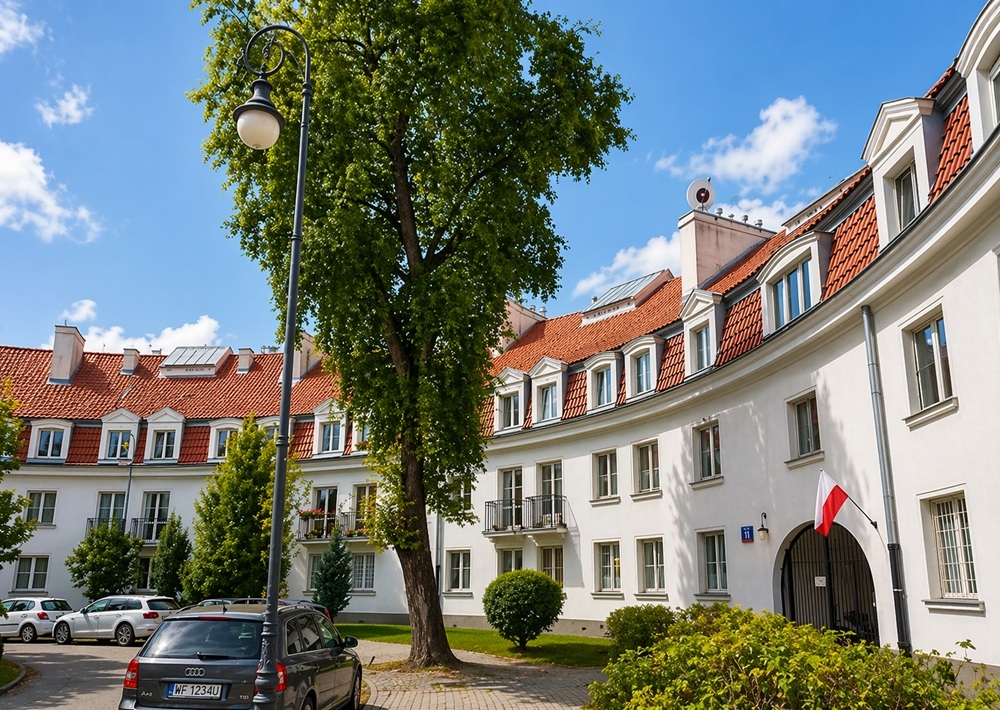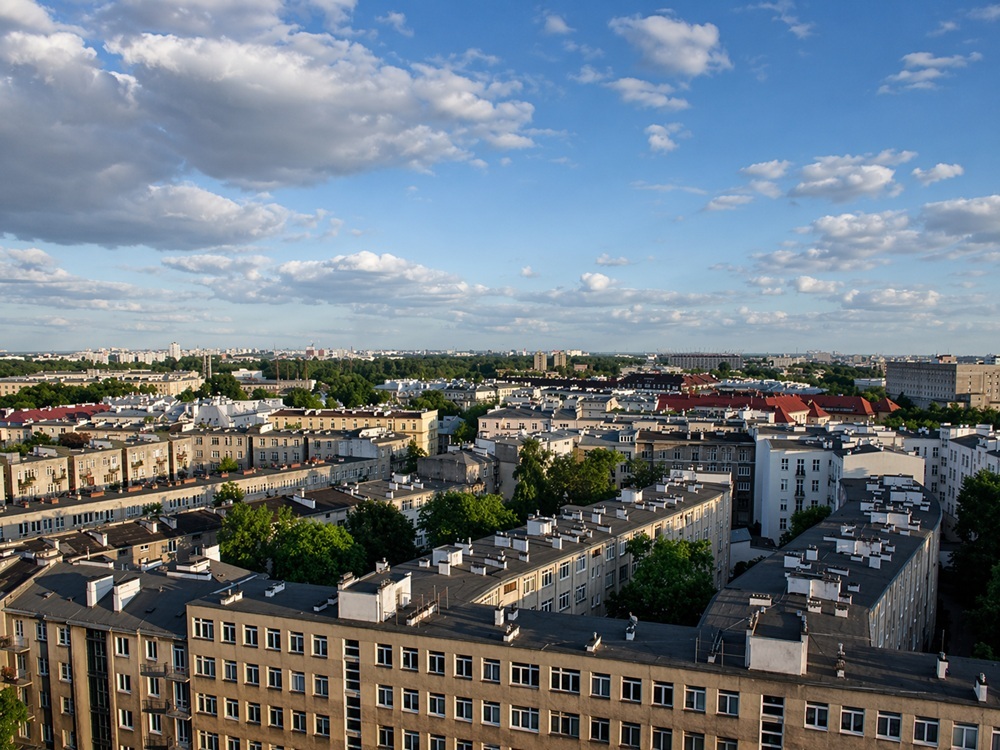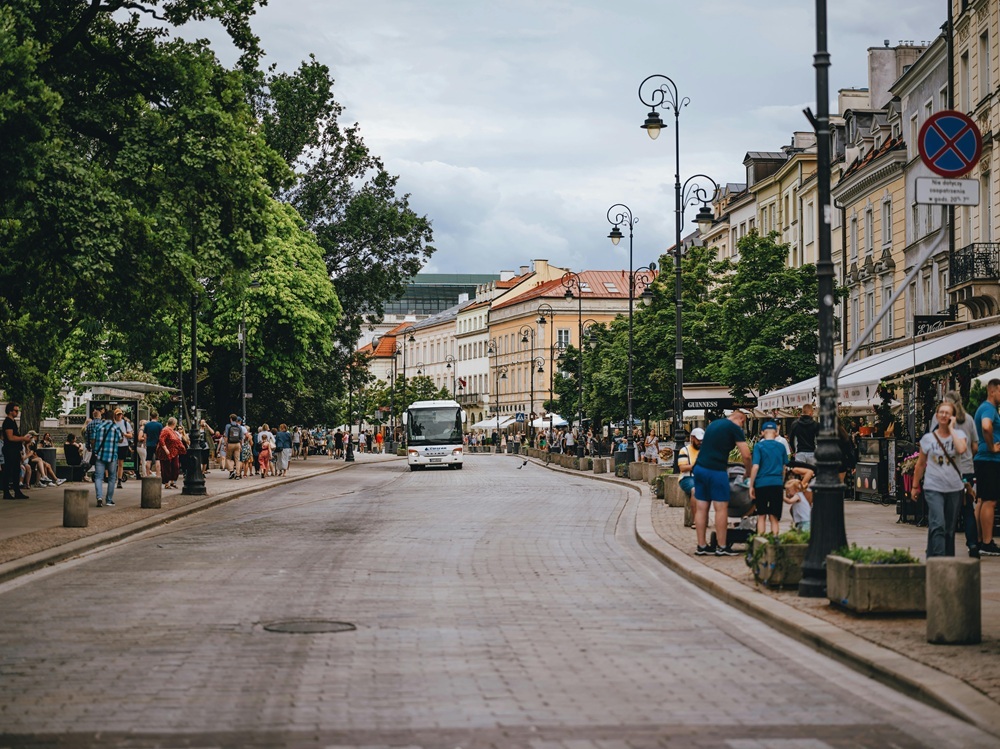
 Warsaw from above — a large, dense capital where official statistics matter more than impressions
Warsaw is a capital of close to two million residents, with a much larger daily inflow of commuters and visitors — so raw crime counts will always look larger here than in a small town. That is true of every major capital and is not, on its own, informative. What matters far more to a newcomer is the type of crime being recorded and where it concentrates. The Komenda Stołeczna Policji — the Warsaw City Police — publishes a monthly and cumulative crime catalogue for the capital's police garrison, and the Statistics Poland (GUS) Warsaw office separately tracks crimes confirmed by police in completed proceedings over time. Both consistently show the same structural pattern seen in most large European capitals: property crime and theft dominate the caseload, while crimes against life and health are a small minority. Figures shift release to release, so the current totals should always be checked directly at the live source rather than repeated from a secondary summary that may already be out of date.
| Source | What it measures | What it tells a foreign resident or buyer | Practical interpretation |
|---|---|---|---|
| Warsaw City Police (KSP) | Monthly and year-to-date crime catalogue for the Warsaw garrison, by category | Which crime types are actually recorded, and roughly how the caseload splits between property and violent crime | Check the current release directly — figures change monthly and a quoted number here would already be stale |
| KSP Traffic Division | Warsaw-specific road, pedestrian and cyclist incident data | Road safety, not street crime, is the larger everyday risk for families — see §7 | Worth checking directly rather than a national average, since road risk varies by street and district |
| GUS Warsaw safety monitoring | Crimes confirmed by police in completed proceedings, tracked over time for the Warsaw region | A longer-term, methodologically consistent view than a single month's police catalogue | Useful for spotting multi-year trend direction rather than a single current figure |
| City of Warsaw official reporting | Municipal quality-of-life and public-order context, published periodically | Investment in lighting, transport and shared public space that shapes how safe the city feels beyond raw crime counts | Check the current edition on the city's official site rather than a cached copy |
| US State Department | US government advisory level (1 to 4) for Poland | An independent government risk rating, separate from Polish police data | At the time of this review, Poland is rated Level 1 — "Exercise Normal Precautions," the lowest tier — always check the live page, since levels change |
| UK FCDO | UK government risk assessment for British nationals | Whether Poland is currently treated as a normal-precautions destination by a major foreign government | Does not advise against travel to Warsaw; its specific caution concentrates on the area near the Ukrainian border |
| Government of Canada | Canadian government risk assessment for Poland | A third independent government view, useful for cross-checking the US and UK assessments | Advises "take normal security precautions in Poland" — its standard, lowest-tier guidance |
| Polish government information on 112 | Confirms 112 as the general EU-wide emergency number, functional throughout Poland | Which number to call by default in any emergency, regardless of nationality or language | Save it before you need it — full emergency-number table in §9 |
Taken as a whole, these sources point in one direction: Warsaw is generally safe by large European capital standards, and violent street crime is not a normal part of everyday life for most residents. Property crime, theft, road safety and, for newcomers unfamiliar with the local system, transactional risk are the more realistic categories — which is why this guide gives them more space than crime headlines. All figures should be checked at the live official source at the time you read this, since both crime statistics and travel advisories are reviewed on a rolling basis.