
Warsaw Investor Care logo
Buyer decision guide · Warsaw · Updated July 2026

New build vs resale
in Warsaw.

A data-driven comparison for foreign buyers — covering total acquisition cost, tax differences, rental yield potential, legal risk profile and the scenarios where each market genuinely outperforms the other.

Covers: PCC tax · VAT · fit-out cost · stan deweloperski · yield · liquidity · legal risk Also read: New-build guide · Total costs · Buying process

The new build versus resale question is one of the most commonly asked — and most superficially answered — questions in Warsaw real estate. Most comparisons stop at headline price or building age. A serious capital allocation decision requires something more precise: a full-stack comparison of total cost of entry, legal risk profile, income timeline, yield potential and realistic exit liquidity across both market segments.

Warsaw's primary and secondary markets behave differently in material ways. The primary market carries a statutory buyer protection framework and a PCC tax exemption that the secondary market does not. The secondary market offers immediate income potential, established neighbourhood quality signals and architectural character that developer stock cannot replicate. Neither is categorically superior — the right choice is determined by the buyer's capital structure, income timeline, risk tolerance and holding strategy. This guide maps the real trade-offs with current Warsaw market data.

PCC tax — resale
2% of price
On an 800,000 PLN unit: 16,000 PLN additional cost versus zero on standard developer sale
Fit-out cost — new-build
2,200–3,500 PLN/m²
Must be added to developer price for true total entry cost comparison
Time to first rental income
0–3 months resale
vs 18–42 months new-build off-plan including construction and fit-out period
Warsaw gross yield range
4.8–7.2%
NBP benchmark 5.56% Q3 2025 — metro-adjacent units reach upper band
Methodology

Why most new-build vs resale comparisons reach the wrong conclusion

The comparison fails when it uses headline purchase price as the basis. Total capital deployed — not the price on the developer's brochure — is the only figure that produces a valid yield and return calculation.

Construction site with cranes, illustrating that most Warsaw developer apartments are delivered in shell condition (stan deweloperski) Most Warsaw developer apartments are not delivered as finished homes — fit-out capital must be added to the true entry cost

A typical comparison looks like this: a new-build apartment in Wola at 850,000 PLN is being weighed against a resale apartment in Mokotów at 820,000 PLN. On this framing, the new-build looks marginally more expensive. On a full-capital comparison, the picture is entirely different.

The new-build carries: 0% PCC, but requires 55 m² × 2,600 PLN/m² = approximately 143,000 PLN in fit-out before the apartment generates any income. Total entry capital: approximately 993,000 PLN — plus a 14–20 month void period from handover to first rental income if the apartment is off-plan.

The resale apartment carries: 2% PCC = 16,400 PLN, notary fees approximately 5,500 PLN, but is delivered in finished condition and can be rented within 4–6 weeks of purchase after minor redecoration. Total entry capital: approximately 841,900 PLN, with income starting 5–8 weeks from signing.

On a 5-year gross yield calculation at 5.5%, the resale apartment generates approximately 231,500 PLN in gross rental income before the new-build — purchased at the same moment — has received its first tenant. This void-period gap is the single most underweighted variable in new-build vs resale comparisons, and it compounds materially over a typical investment horizon.

None of this means the new-build is the wrong choice. It means the comparison must be built correctly. The new-build may offer superior building quality, lower maintenance risk, a PCC saving that partially offsets fit-out cost, and location upside in a district with active infrastructure development. These are legitimate advantages that belong in the model — alongside the fit-out cost, the void period value and the construction risk. The comparison that matters is total capital deployed versus total income generated over the holding period, not headline price versus headline price.

The correct comparison framework

For any Warsaw property decision: calculate (a) total capital deployed including all acquisition costs and fit-out, (b) realistic months to first rental income, (c) annual gross yield on total capital, (d) expected capital growth rate over holding period, (e) exit liquidity — transaction speed and buyer depth. Only once all five are established does the comparison become meaningful.

New-build advantage

PCC exemption — structural cost saving

Standard developer sales of residential apartments are exempt from the 2% PCC civil law transaction tax (Art. 2 pkt 4 Ustawy o PCC). On an 800,000 PLN purchase, this is 16,000 PLN not paid — a real saving that partially offsets fit-out costs on smaller apartments.

Resale advantage

Immediate income — no fit-out void

A well-selected resale apartment in a lettable condition generates rental income within 4–8 weeks of purchase. Over an 18–24 month off-plan new-build void period at 3,500 PLN/month net rent, the resale buyer accumulates 63,000–84,000 PLN in income the new-build buyer has not received.

Context-dependent

Location upside — depends on district and timing

New-build outperforms on capital growth when purchased in a district with confirmed infrastructure improvement ahead — M3 metro line in Praga, Wola CBD expansion. Resale outperforms in established districts where land scarcity constrains new supply and tenant demand is structurally deep — Żoliborz, central Mokotów.


Total cost of entry

Tax structure and total acquisition costs — primary vs secondary market

The tax differential between new-build and resale is real and significant. But it is only one component of a multi-variable total cost comparison that most buyers fail to complete before committing.

Investment comparison analysis for Warsaw property — calculating new-build versus resale total acquisition costs Total capital modelling is the foundation of any valid primary vs secondary market comparison
Cost component New-build (primary market) Resale (secondary market) Note
PCC civil law transaction tax Zero (standard residential sale) 2% of agreed price Art. 2 pkt 4 Ustawy o podatku od czynności cywilnoprawnych — exemption applies where VAT is charged on the transaction
VAT 8% on residential ≤150 m² (embedded in developer price); 23% on parking and storage Not applicable on private individual resale VAT on developer sale means buyer cannot separately claim it — price quoted is gross
Notary fee (taksa notarialna) 0.5–1% of price, statutory cap approx. 10,000 PLN on higher-value transactions Same statutory scale Set by Rozporządzenie Ministra Sprawiedliwości — not negotiable
Land register court fee 200 PLN 200 PLN Collected by notary at signing, filed within 3 business days
Estate agent fee Typically zero — developer sells direct or via own team 2–3% + 23% VAT of transaction price Varies significantly; some sellers absorb agent fee — confirm before signing
Fit-out / renovation 2,200–4,500+ PLN/m² — mandatory before habitation or rental Zero to moderate — finished units lettable immediately; renovation units require separate budget Stan deweloperski is standard delivery on primary market; resale delivers in existing condition
Void period cost (opportunity cost) 14–30+ months off-plan: construction + fit-out before income begins 4–8 weeks to first rental income on lettable resale unit At 3,500 PLN/month net rent, 18-month void = 63,000 PLN in foregone income
Legal counsel 3,000–8,000 PLN for full transaction support 3,000–8,000 PLN for full transaction support Essential on both markets — do not substitute with developer's in-house legal team on primary market

On a 55 m² apartment purchased at 900,000 PLN, the fully loaded comparison looks as follows. New-build: 900,000 PLN purchase + zero PCC + 5,500 PLN notary + 200 PLN KW + 143,000 PLN fit-out (55 m² × 2,600 PLN/m²) = approximately 1,048,700 PLN total capital deployed before income begins. Resale: 900,000 PLN purchase + 18,000 PLN PCC + 5,500 PLN notary + 200 PLN KW + minimal redecoration = approximately 923,700 PLN total capital deployed, with income starting 5–8 weeks from signing.

The 125,000 PLN difference in total entry capital is the figure that belongs in the yield calculation — not the 0 PLN PCC saving in isolation.

Annual property tax — equal on both markets

Podatek od nieruchomości (property tax) is assessed on building area regardless of market origin and is set by local municipality. In Warsaw, rates for residential property are capped at 1.19 PLN/m² per year under the 2026 limits set by Obwieszczenie Ministra Finansów — a marginal cost that does not materially differentiate new-build from resale in the investment model.

Investment performance

Rental yield and capital return — what the data shows for each market

Yield is generated by two variables: rental income and total capital deployed. Both differ between primary and secondary market in ways that require careful modelling rather than market-level generalisation.

Warsaw gross rental yields across both market segments range from approximately 4.8% in less liquid secondary market locations to 7.2% in optimally located modern stock close to M2 metro stations, according to market data from Otodom Analytics and NBP residential market reports. The NBP benchmark capitalisation rate for Warsaw was 5.56% in Q3 2025. These figures apply to gross yield — net yield after management fees (8–12%), maintenance charges (czynsz), property tax, income tax and periodic vacancy runs approximately 1.5–2.2 percentage points lower.

New-build yield mechanics. The primary market yield calculation must use total capital including fit-out as the denominator — not purchase price alone. A 55 m² Wola apartment at 900,000 PLN with 143,000 PLN fit-out generates yield on 1,043,000 PLN of capital deployed, not on 900,000 PLN. At 4,200 PLN/month gross rent (current Wola 2BR average per Otodom Q1 2026 data), gross yield is 4.83% on total capital versus 5.6% if incorrectly calculated on purchase price alone. The difference is not cosmetic — it determines whether the investment clears the buyer's return threshold.

The upside case for new-build is capital appreciation, not current yield. Well-selected Wola and Praga Południe primary market stock has historically appreciated at 6–9% annually in the 2020–2024 period, driven by infrastructure improvement and migration into modern residential. The total return case — yield plus appreciation — frequently outperforms a comparable resale investment over a 7–10 year horizon despite the lower initial yield and extended void period at entry.

Resale yield mechanics. The secondary market offers more immediate yield clarity — the apartment exists, comparable rental transactions are observable, and income begins within weeks of purchase. A well-selected Mokotów 2BR resale at 850,000 PLN total cost (including PCC and notary) generating 4,100 PLN/month gross rent produces a gross yield of 5.79% from month 2. This is real, current income — not a projection dependent on construction completion and fit-out execution.

The resale market also carries a structural advantage in certain district-product combinations: pre-war apartments in Żoliborz, Śródmieście and Praga Północ consistently command rental premiums over comparable new-build square meterage due to ceiling height, layout efficiency and neighbourhood character. In these submarkets, resale stock is not simply "older" — it is a differentiated product with a distinct tenant profile (typically professional couples and expats with longer tenancy durations) that justifies a premium rental level the new-build cannot reach in the same location.

Rental income tax in Poland — identical on both markets

Rental income from both new-build and resale apartments is taxed identically under Polish law. From 2023, private landlords must apply the ryczałt (flat-rate tax) system: 8.5% on annual rental income up to 100,000 PLN, 12.5% above this threshold. Expenses are not deductible under ryczałt. Corporate ownership structures may apply different tax treatment — verify with a Polish tax adviser for any specific structure.

What you actually buy

Product quality, character and tenant appeal — the differences that matter in practice

The apartment itself — what it looks like, how it functions and what kind of tenant it attracts — differs between primary and secondary market in ways that headline yield numbers do not capture.

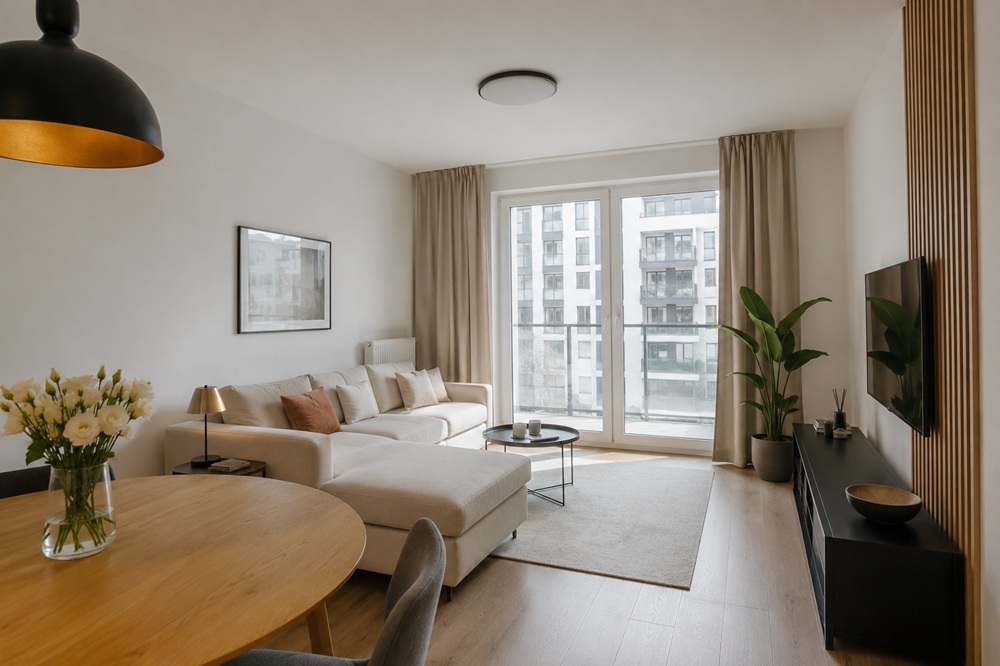
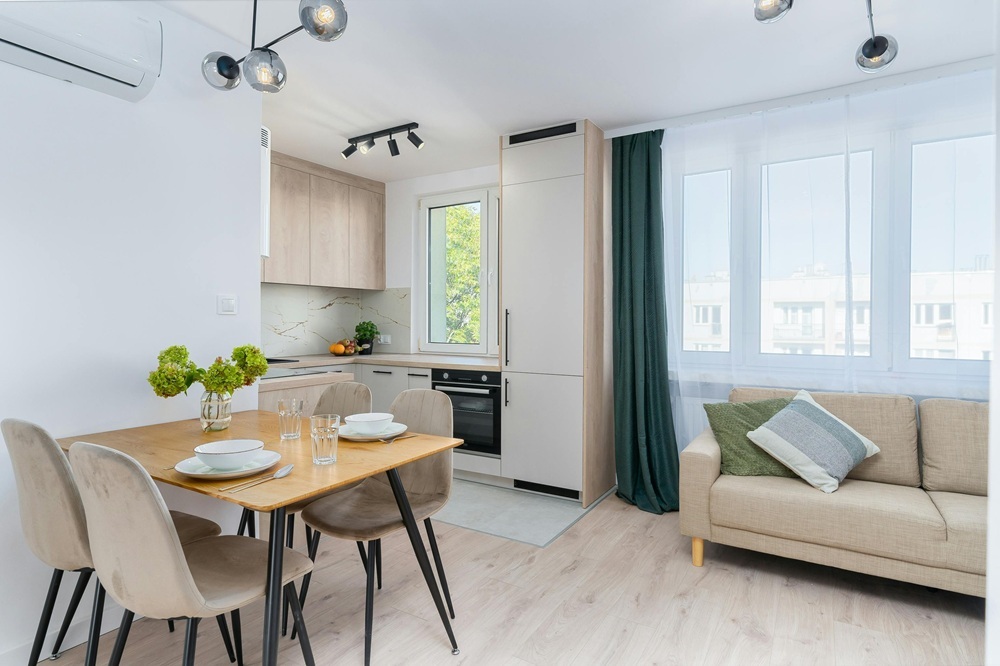
Finished new-build apartment interior in Warsaw — modern open-plan living with balcony access and contemporary fit-out
Resale apartment interior in Warsaw — original herringbone parquet, high ceilings and period character in a pre-war tenement

New-build product characteristics

  • Current energy efficiency standards — EPC ratings typically A or B under post-2021 building regulations; lower utility costs for tenants versus older stock
  • Open-plan layouts optimised for modern living — combined kitchen/living, larger windows, higher usable floor-area efficiency
  • Balcony or terrace standard on most post-2015 Warsaw projects — a letting advantage in a market where outdoor space commands a premium post-2020
  • Consistent fit-out if investor-managed — no substrate surprises, no hidden age defects in walls and floors
  • Underground parking typically included or available — standard expectation for corporate tenant segment in Wola and Mokotów new stock
  • Building management coherent from day one — new lift, clean common areas, functioning entry systems; no legacy maintenance backlog

Resale / pre-war product characteristics

  • Ceiling heights of 3.0–3.6m in pre-war stock — a structural advantage that new-build cannot replicate and that tenants in premium segments actively seek
  • Herringbone parquet, original cornicing, period door frames — architectural character that commands genuine rental and resale premiums in Żoliborz, Śródmieście, central Mokotów
  • Established neighbourhood density — bakeries, independent cafes, street life and walking-distance amenities that new residential clusters require years to develop
  • Larger per-unit floor area at equivalent price points — pre-war Warsaw apartments frequently offer 60–80 m² at prices where new-build delivers 45–55 m²
  • Immediate inspection — you can assess exactly what you are buying before any commitment; no off-plan projection dependency
  • Lower entry barriers in certain districts — Praga Północ and outer Mokotów resale offers entry below primary market pricing with strong rental demand from the existing tenant base
The tenant-type distinction

Corporate professionals and short-term expat tenants typically prefer modern new-build stock in Wola — proximity to CBD, new building quality, parking, modern fit-out. Long-term professional tenants and families frequently prefer pre-war character apartments in Żoliborz, Mokotów and Śródmieście — ceiling height, layout, neighbourhood permanence. Matching the product to the target tenant segment is as important as the headline yield calculation.

Buyer guidance

Decision matrix — when new-build wins and when resale wins for Warsaw investors

Neither market is superior in the abstract. The correct choice is determined by a specific combination of buyer profile, capital structure, income timeline and holding strategy.

New-build is stronger when:
  • You can deploy the full capital stack — purchase price plus fit-out — without income from the property during the construction and fitting-out period
  • Your target district is Wola, Praga Południe near the planned M3 metro corridor, or another area with confirmed future infrastructure improvement — new-build captures the appreciation thesis more cleanly
  • You want the PCC saving to offset a portion of fit-out cost — particularly relevant on sub-600,000 PLN transactions where 2% PCC represents a meaningful fraction of total fit-out budget
  • Your brief is a standardised, legally protected transaction with no title ambiguity and a new building requiring no near-term technical maintenance
  • You have a 7–10 year holding period and are targeting total return (yield plus capital growth) rather than current income yield alone
  • The specific project is at a late construction stage — 80%+ complete — reducing delivery timeline risk to 3–6 months rather than 24–36 months
Resale is stronger when:
  • Your financial model requires rental income to begin within 2–3 months of purchase — the void period on a new-build off-plan purchase makes this impossible
  • Your target is Żoliborz, central Mokotów, Śródmieście or Praga Północ — districts where pre-war character stock commands structural rental and resale premiums over new-build, and where primary market supply is limited
  • The specific resale unit is finished, well-located and priced such that total entry cost (including PCC) is materially below the equivalent new-build plus fit-out total in the same area
  • You want to inspect exactly what you are buying before any contractual commitment — layout, condition, views, noise, building quality — without off-plan projection dependency
  • Architectural character — ceiling height, original parquet, pre-war proportions — is a material part of the tenant value proposition you are building
  • You are targeting a 3–5 year holding period where maximising current yield on minimum capital outperforms a longer-horizon appreciation thesis
Decision variable New-build wins Resale wins Too close to call
Total acquisition cost (all-in) Rarely — fit-out adds 15–18% to purchase price Usually — PCC + notary adds 2–3% versus 15–18% fit-out When resale requires significant renovation
Time to first rental income Never on off-plan; only on completed units Always on lettable resale stock Completed new-build vs renovation resale
Current gross yield on capital Weaker — higher total capital, later income start Stronger — lower total capital, earlier income When new-build is Wola/metro-adjacent premium tier
5–10 year capital appreciation Stronger in infrastructure-improving districts Stronger in supply-constrained established districts Broadly similar in mature submarkets
Legal risk — manageable with due diligence Delivery and specification risk — mitigated by escrow Title and condition risk — mitigated by KW review and inspection Both require professional legal support
Building quality and maintenance Stronger — new systems, no legacy maintenance backlog Variable — depends on building and management quality Post-2000 resale vs well-maintained pre-war stock
Architectural character and tenant premium Cannot replicate pre-war proportions Structural advantage in character-premium submarkets Modern districts where character premium is absent
Exit liquidity — resale speed and buyer depth Strong in Wola, moderate in peripheral new-build clusters Strong in established districts; weaker in outer zones Location-specific rather than market-type-specific
FAQ

New build vs resale in Warsaw — frequently asked questions

The questions that matter most for buyers deciding between the two markets — answered with specificity rather than safe generalities.

Is new-build always cheaper in Warsaw because of the PCC exemption?

No — and this is the most common misconception in the comparison. Standard developer sales are exempt from the 2% PCC tax, but new-build apartments are delivered in stan deweloperski (developer shell condition) that requires 2,200–4,500+ PLN/m² of fit-out capital before the apartment is habitable or rentable. On a 55 m² apartment, fit-out at medium standard costs approximately 121,000–165,000 PLN — far exceeding the PCC saving of 18,000 PLN on a 900,000 PLN purchase. The total entry cost on new-build is almost always higher than on a comparable resale in lettable condition, even accounting for the PCC exemption. The correct comparison is total capital deployed, not purchase price minus PCC.

Which market produces higher rental yield in Warsaw?

On a total-capital basis, well-selected resale apartments in established Warsaw districts typically produce higher current gross yield than new-build primary market stock — because resale total entry cost is lower and income begins earlier. On a purchase-price-only basis (which is methodologically incorrect), the difference narrows. However, new-build in high-demand new-stock locations — Wola, metro-adjacent Mokotów — can close the gap when rental premiums for modern building quality are priced in. The highest gross yields in Warsaw (6.5–7.2%) are typically found in well-located 1BR and studio apartments of either market type purchased at below-average prices per m², not in one market exclusively.

Is buying off-plan in Warsaw significantly riskier than buying a completed unit?

Off-plan purchases carry construction and delivery risk that completed-unit purchases do not. However, Polish law (Ustawa Deweloperska 2021) provides meaningful statutory protections: buyer payments are held in protected escrow accounts (rachunek powierniczy) and released only against confirmed construction milestones; the Deweloperski Fundusz Gwarancyjny provides additional compensation coverage for projects commenced after 1 July 2022. A well-selected project from a developer with a clear track record and late-stage construction is materially less risky than a ground-up pre-sale from an unproven developer. Developer due diligence is not optional on off-plan purchases.

Do resale apartments in Warsaw command higher rents than new-build?

In certain district-product combinations, yes. Pre-war apartments in Żoliborz, Śródmieście and Praga Północ with ceiling heights of 3.0–3.6m, original parquet and established neighbourhood character consistently command rental premiums of 8–15% over comparable new-build square meterage in the same postal district, based on Otodom transaction data. This premium is driven by a specific tenant segment — longer-tenure professional tenants and expat families who value architectural character and walking-distance neighbourhood quality over building age. In districts where character stock does not carry this premium — Wola, outer Białołęka, Wilanów — modern new-build typically achieves equal or higher rents due to building quality and parking provision.

Can Warsaw Investor Care advise on both new-build and resale purchases?

Yes. We work across both market segments and deliberately do not have a structural preference for either — our role is to identify the option that best matches the buyer's capital structure, income timeline and investment brief, not to push a single product type. For buyers comparing specific primary and secondary market options, we can model total capital, income timeline and yield across both before any commitment is made. See our services overview or schedule a consultation to discuss your specific brief.

Next step

Not sure which market fits your brief?

The right answer depends on your capital structure, income timeline and target district — not on a general preference for new or old. We model both options before any commitment is made.

Finished living room with open kitchen in a Warsaw apartment, representing a well-executed purchase outcome

Let's build the correct comparison for your brief.

We help foreign buyers compare specific primary and secondary market options on a full-capital basis — total cost, income timeline, yield and exit liquidity — before any commitment is made. Both markets, one point of contact, in English.

Full-capital cost modelling
Primary & secondary market coverage
Legal coordination & due diligence
Fit-out management post-handover
Rental activation
Data sources and update notes

Data point updated: July 2026.

Market and yield figures are based on NBP residential market reports and Otodom transaction data. Tax and legal references are based on the official consolidated texts of the Act on Civil Law Transactions Tax (ustawa o PCC) and the 2021 Developer Protection Act (ustawa deweloperska), both published on isap.sejm.gov.pl. All figures are indicative and should be independently verified with a qualified Polish lawyer or tax adviser for any specific transaction.

Related guides & services

Guide

New Build Apartments in Warsaw

Complete primary market guide — developer process, stan deweloperski, escrow protection and unit selection strategy.

Guide

Total Cost of Buying in Warsaw

Every acquisition cost itemised — PCC, notary, agent fees and fit-out budgets for accurate total capital planning.

Guide

Buying Process in Warsaw

Step-by-step transaction guide — notarial deed, land register, POA logistics and payment structure for foreign buyers.

Guide

Best Districts in Warsaw

Full district comparison — pricing, yields, metro access and buyer profiles to choose where before choosing what.

Service

Renovation & Finishing

Stan deweloperski to rental-ready — budget tiers, timeline and remote project management for new-build fit-out.

Service

Legal Coordination

Developer agreement review, KW due diligence, notarial signing preparation — both markets covered.

© 2026 Warsaw Investor Care. All rights reserved.

Legal notice: This page is for informational and marketing purposes only. It does not constitute legal, tax, financial or investment advice. All market data, yield figures, pricing estimates, tax rates and cost benchmarks are indicative as of June 2026 and are subject to change — they must be independently verified with a qualified Polish lawyer, tax adviser and local market professional for any specific transaction or investment decision. References to Polish legislation (Ustawa o PCC, Ustawa Deweloperska, Kodeks Cywilny) reflect the law as understood at the date of publication and may have been amended. Warsaw Investor Care is not a licensed real estate agent, legal adviser, financial adviser or tax consultant. Any reliance on this content is at the reader's own risk.