



Yes — a foreign national can inherit an apartment, house or land in Poland.
The correct route depends on more than the property address. First establish the law and authority governing the succession, then confirm the heir, check any foreign-acquisition permit issue, complete Polish tax formalities and disclose the heir in the land and mortgage register.
Ownership passes under succession law, but the heir still needs a document that can be used against third parties and in the Polish register. A Polish court decision, a registered notarial deed certifying succession or, in an appropriate cross-border EU case, a European Certificate of Succession may provide that proof.
This guide separates those steps because the most expensive mistakes happen when someone treats “inheritance” as one event. In practice it is a sequence involving succession law, debts, evidence, Polish tax, the property register and sometimes the foreign-acquisition regime.
 Start with the will, family line, property title and cross-border facts — not with assumptions about the apartment alone.
The property is in Poland. The succession law may not be Polish.
Cross-border inheritance begins with the deceased’s life, not simply the location of one asset.
Under the EU Succession Regulation, the general rule is that the law of the state in which the deceased had their habitual residence at death governs the succession as a whole. A person may instead choose the law of a state whose nationality they hold, provided that choice is made in the required form.
Habitual residence
Where the deceased’s life was actually centred at death — assessed from the complete circumstances.
Law of nationality
A valid choice in a will can replace the default law with the law of one of the deceased’s nationalities.
Polish property formalities
Even where foreign succession law applies, the Polish asset, register, tax and permit issues still require a Polish execution plan.
They are connected but not identical. The authority handling the succession must establish its jurisdiction and the applicable law; the Polish land register then needs acceptable evidence showing who inherited the property.
Prove who inherited before planning what to do with the apartment.
A will alone normally does not replace formal confirmation of succession.
 A registered Polish notarial succession certificate can have the effect of a final court declaration — when the notarial route is available.
Polish law recognises two principal domestic routes: a court declaration confirming acquisition of the inheritance or a registered notarial deed certifying succession. The notarial route is efficient where the facts, jurisdiction, applicable law and identity of every interested person are clear. A notary must refuse if required participants are missing, another succession confirmation already exists or the matter falls outside Polish jurisdiction.
Declaration of acquisition
Useful where facts are disputed, heirs are missing, foreign-law questions are complex or the notarial route is unavailable.
Registered succession certificate
Possible when all necessary persons and evidence are available and the notary has no relevant doubt.
European Certificate of Succession
Designed to let heirs prove status and powers across participating EU states without a separate procedure for each use.
The appropriate route depends on the deceased’s habitual residence, any choice of law, where proceedings have started, whether there is a will, the location of the heirs and whether the result must be used in more than one country.
Do not value the apartment without valuing the liabilities.
Inheritance can include mortgage debt, private loans, tax arrears, service charges and other obligations.
Under the Polish Civil Code, an heir generally has six months from learning of the legal basis of their entitlement to accept or reject the inheritance. Silence generally results in acceptance with the benefit of inventory, which limits liability by reference to the net value established in the inventory — but it does not remove the work of identifying creditors, securing records and dealing with the property.
Confirm the property position.
Check the land register, mortgage, enforcement entries, co-ownership, occupancy, leases, community charges, utilities and physical condition.
Build the estate balance.
Identify bank debt, tax, unpaid fees, private claims, funeral costs and expenses already paid by individual heirs.
The statutory trigger is when the heir learns of the basis on which they are called to inherit. The date is fact-sensitive, so record how and when that knowledge arose and obtain advice before the period expires.
Statutory heir, testamentary heir and nationality are not the same test.
This is the point most often reduced to an inaccurate “foreigners need permission” statement.
 The permit analysis must match the heir, legal basis and exact property — it should not be guessed from nationality alone.
Article 7 of the Polish Act on the Acquisition of Real Estate by Foreigners excludes inheritance or a vindicatory legacy by a person entitled to statutory inheritance from the permit regime. If the applicable succession law has no statutory inheritance, Polish law is used to assess whether the beneficiary belongs to that circle.
A foreign testamentary heir who is not a statutory heir requires a separate analysis. The Act provides that where such a foreigner inherits Polish real estate under a will, an application for the relevant ministerial permit must be filed within two years from the opening of the succession; otherwise the statutory heirs may acquire the property. At the same time, EEA and Swiss nationals benefit from a broad general permit exemption, and other statutory or property-specific exemptions may apply.
Person entitled by statute
The inheritance exception focuses on whether the person belongs to the statutory heir circle, even when the will also names them.
EEA or Swiss national
The current MSWiA guidance confirms the general exemption under Article 8(2), subject to the exact facts and special regimes.
Non-statutory will beneficiary
For a non-exempt foreigner, the two-year statutory window makes early specialist review essential.
These can add separate restrictions or approvals. Obtain a written case analysis from the notary or qualified lawyer and, where needed, MSWiA rather than relying on a general internet checklist.
Prepare documents for use in Poland before booking the decisive appointment.
The correct authentication route depends on the issuing country and the document.
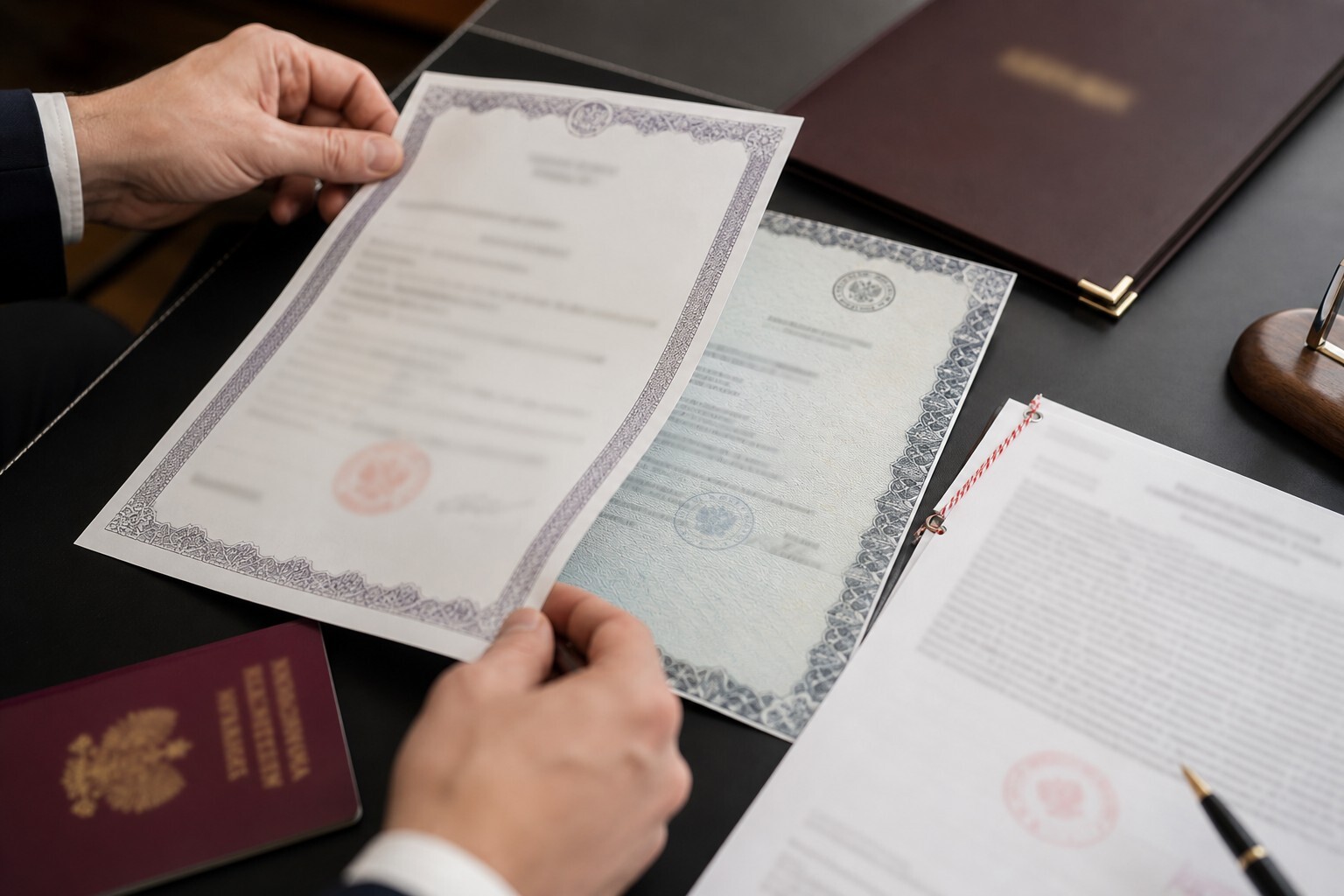 Do not obtain an apostille automatically: some EU public documents, including death records, are exempt from apostille under EU rules.
A death certificate issued by another EU state and covered by Regulation (EU) 2016/1191 cannot be required to carry an apostille merely for presentation in another EU state. A multilingual standard form may also reduce translation needs. Documents from outside that regime may require an apostille under the Hague Convention or diplomatic legalisation, depending on the country and any treaty.
- death certificate and evidence of the deceased’s last habitual residence;
- original will, codicils and information about any registered will;
- civil-status records proving family relationships;
- passports, identity data and current addresses of all relevant heirs;
- property land-register number, acquisition deed, community records and mortgage information;
- foreign judgments, succession documents or European Certificate of Succession, if already issued;
- apostille or legalisation and sworn Polish translation where actually required.
Ask the Polish notary, court or lawyer which originals, certifications and translations they require before ordering them. Authentication obtained in the wrong form can still be unusable.
The family exemption has both a relationship test and a status test.
A close relative should not assume the exemption is automatic or that the deadline runs from the death.
 Polish real estate is within the Polish inheritance-tax scope; exemption and filing depend on the heir’s exact position.
Polish inheritance and donation tax applies to an individual acquiring property located in Poland. The closest-family exemption covers a spouse, descendants, ascendants, stepchildren, siblings, stepfather and stepmother, but Article 4(4) also requires the beneficiary at acquisition to have Polish, EU or qualifying EEA citizenship, or residence in Poland, the EU or qualifying EEA state.
Where the exemption applies, each heir generally files SD‑Z2 within six months from the final court declaration, registration of the notarial succession certificate or issuance of the European Certificate of Succession. The deadline is therefore tied to the formal confirmation event — not automatically the date of death.
File SD‑Z2 on time.
The exemption can cover the full value, but the statutory family, citizenship/residence and filing conditions must all be met.
Expect a Polish assessment.
The tax group, relationship, net market value, debts and previous acquisitions from the same deceased affect the result; SD‑3 may be required.
For qualifying acquisitions, the law now allows restoration of the SD‑Z2 deadline on application where the heir makes it plausible that the delay occurred without their fault. The application procedure is strict and should be handled immediately; it is not a substitute for filing on time.
If the inherited property will later be sold or mortgaged, tax evidence may also be required for the notarial transaction. Since 2025, the Act contains an exception in specified cases, including property exempt under Article 4a, but the notary should confirm exactly which tax-office certificate or consent is needed for the planned deed.
Inheritance creates the right. The register must show it.
A clean land-register update is the bridge between succession and any later sale, mortgage or division.
 Match the succession document to the owner, share, apartment, associated rights and current land-register content.
The heir normally applies to disclose the change of ownership in the land and mortgage register using acceptable evidence of succession. The court or notary may notify the land-register court of the ownership change, but the heir still needs to ensure the appropriate entry is completed and that the inherited share matches the succession document.
- verify the exact land-register number and whether the apartment has a separate register;
- compare Section II ownership data with the succession document;
- review mortgages, claims, easements and enforcement entries;
- identify associated parking, storage, land shares or cooperative rights;
- check notices and pending applications before planning a disposal.
A share in the estate is not the same as a finished division of the apartment.
Co-heirs need rules for access, costs, income and the end decision.
 Before renovation or sale, document who can decide, who pays and how use or rental income is accounted for.
Until the estate is divided, each co-heir has a share in the inheritance rather than an independently selected room or physical part of the apartment. Decisions about occupation, letting, major works, sale and reimbursement of expenses should be recorded instead of left to informal family expectations.
Co-own and manage.
Agree decision rights, funding, rent, use, insurance, reporting and a future exit mechanism.
Divide the estate.
One heir may take the property with equalisation payments. If the estate includes real estate, an agreed division requires notarial form.
Prepare a sale.
Complete title, tax and representation first, then agree valuation, costs, signatures, banking and handover.
Most practical work can be coordinated remotely — if authority is designed first.
A generic power of attorney downloaded online is a common source of delay.
 Approve the Polish powers and signing form before the document is executed abroad.
 Local access, bills, insurance and inspections continue while the succession is being resolved.
A representative may be able to obtain records, coordinate the notary or lawyer, file applications, manage the apartment and complete selected acts. The required authority depends on the task. Property disposal, estate division and other notarial acts need powers drafted for those exact transactions and executed in the proper form.
- have the Polish notary or lawyer approve the wording before signing abroad;
- confirm notarisation, apostille/legalisation and sworn-translation requirements;
- state powers for succession, tax, land register, administration, banking and sale separately;
- arrange secure delivery of the original document where required;
- keep property access, insurance and urgent repairs operational meanwhile.
From notification of death to a usable Polish title.
The order reduces duplicated translations, incorrect filings and premature decisions about the property.
Secure information and the property
Locate the will, death record, family documents, keys, insurance, land-register number, bills and immediate risks.
Map the cross-border case
Record habitual residence, nationalities, any choice of law, existing proceedings, heirs and assets in every country.
Assess debts and the six-month decision
Identify liabilities and obtain advice on acceptance, rejection and inventory protection before the heir’s deadline.
Choose the confirming authority
Use the appropriate court, notarial or European Certificate route and gather documents in the required form.
Check the foreign-acquisition position
Confirm the statutory-heir exception, nationality exemption and any permit or special property regime.
Complete Polish tax formalities
File SD‑Z2 or the required tax return by the correct deadline and retain evidence for future notarial acts.
Update the land register
Disclose the heir or heirs and verify that the property, shares and entries match the succession evidence.
Keep, divide, rent or sell
Choose only after title, tax, co-heir authority, property condition and net financial consequences are visible.
Once the legal heir is known, the apartment still needs a local plan.
Legal advice establishes rights. Property coordination turns those rights into a controlled Warsaw asset.
 Coordinate
Documents and access
Connect the heir, property and Polish specialists.
 Keep
KeepPrepare the apartment
Inspect, insure, repair, furnish or position for rent.
 Control
Record possession
Document keys, meters, occupancy and responsibility.
Warsaw Investor Care can coordinate property access, initial condition checks, records, valuation input, local administration, renovation or rental preparation and communication between the heir and appropriately qualified notarial, legal and tax professionals. We do not replace those regulated advisers.
Eight mistakes that turn a manageable succession into a property problem.
Resolve them before anyone pays for renovation, promises a sale or signs a generic power of attorney.
Assuming Polish law applies because the apartment is in Warsaw.
The deceased’s habitual residence and any valid choice of national law must be analysed first.
Treating the will as the final ownership document.
The heir still needs formal proof accepted for dealings with third parties and the register.
Counting every deadline from the date of death.
The Civil Code acceptance period and the tax filing period have different statutory triggers.
Assuming close family always means tax-free.
The exemption also has citizenship/residence and reporting conditions.
Requesting apostille for every EU certificate.
Covered EU public documents cannot be required to carry an apostille under Regulation 2016/1191.
Ignoring the statutory-heir permit exception.
Foreign nationality alone is not the answer; basis of inheritance and exemption status matter.
Renovating before co-heirs agree.
Costs, decisions and reimbursement can become another dispute inside the estate.
Leaving the apartment operationally unattended.
Insurance, leaks, heating, fees, occupants and correspondence continue while legal work is pending.
Foreign heirs and Polish property.
Direct answers to the practical questions that arise before the property can be used, divided or sold.
Can a foreigner inherit an apartment in Poland?
Yes. A foreign national can inherit Polish property. The process must still establish the applicable succession law, heir status, any foreign-acquisition permit issue, Polish tax position and the land-register update.
Does Polish law always govern because the property is in Poland?
No. Under the EU Succession Regulation, the default law is generally the law of the deceased’s habitual residence at death, unless a valid choice of the law of nationality or another rule changes that result.
Is a Polish court case always necessary?
No. Depending on jurisdiction and the facts, heir status may be confirmed by a Polish court, a registered Polish notarial succession certificate or a European Certificate of Succession. The notarial route requires complete participation and no relevant doubt.
Does a foreign heir need an MSWiA permit?
Not automatically. Persons entitled to statutory inheritance fall within the Article 7 inheritance exception. EEA and Swiss nationals also benefit from a broad general exemption. A non-exempt foreign testamentary heir outside the statutory circle requires urgent specialist review because a two-year application rule may apply.
When does the six-month SD‑Z2 period begin?
For inheritance, it generally runs from the final court decision confirming inheritance, registration of the notarial succession certificate or issuance of the European Certificate of Succession — not simply from the death.
Can the SD‑Z2 deadline be restored?
From 2026, restoration may be requested where the heir makes it plausible that the delay was not their fault. The procedural deadline and evidence are strict, so obtain tax advice immediately and do not rely on restoration in advance.
Does every foreign death certificate need an apostille?
No. A covered public document, including a death document, issued in one EU member state cannot be required to carry an apostille for presentation in another EU state under Regulation 2016/1191. Documents from other countries require a country-specific treaty, apostille or legalisation check.
Can I handle the property without travelling to Poland?
Often much of the work can be coordinated through a representative, but powers must be drafted for the exact court, tax, land-register, management, division or sale acts and executed with the required foreign authentication and translation.
Can one co-heir sell the whole apartment?
Not without authority from the others or a completed estate division giving that person the whole property. An individual co-heir generally holds a share in the estate, not unilateral control of the entire apartment.
Can the inherited property be sold immediately?
Only after the seller’s heir status, register, permit position, tax evidence, co-heir authority and notarial documents are ready. A separate Polish income-tax review is also needed because inherited-property sale rules use the deceased’s acquisition date in the five-year test.
Primary rules checked for this guide.
Current consolidated legislation and official guidance reviewed on 1 September 2026.
Regulation (EU) 650/2012
Jurisdiction, habitual residence, choice of law and the European Certificate of Succession.
Dz.U. 2025 poz. 1071
Acceptance and rejection, estate liability, confirmation of succession and estate division.
Foreign acquisition act
Statutory-heir exception and the testamentary inheritance rule.
Inheritance and Donation Tax Act
Tax scope, exemption conditions, deadlines, restoration and notarial tax evidence.
Official filing guide
Who files, deadline trigger, electronic route and closest-family conditions.
Regulation (EU) 2016/1191
Apostille exemption for covered EU public documents and multilingual forms.
European e‑Justice: Poland
Polish succession routes and documents used for the land register.
Ministry of Justice
Official register information, forms and Central Land and Mortgage Register Information.
Control the inheritance through four separate decisions.
Do not collapse law, tax, title and property management into one conversation.
Identify the governing succession.
Habitual residence, nationality choice, jurisdiction and the will determine the legal route.
Obtain usable heir evidence.
Select the correct court, notarial or European certificate and prepare foreign documents properly.
Separate permit and tax tests.
Check statutory-heir and nationality exemptions, then meet the correct Polish tax deadline.
Protect and decide the asset.
Update the register, organise co-heirs and choose to keep, divide, rent or sell with the numbers visible.
Inherited a Warsaw property from abroad?
Send the property address or land-register number, the deceased’s country of residence, your relationship, any will and the current status of the apartment.

Turn the succession into a practical property plan.
We can organise the Warsaw side of the process, secure property information and coordinate local access, records and next steps with the notary, lawyer, tax adviser and other required specialists.
Continue reading
Can foreigners buy in Warsaw?
Permit rules, property types and practical due diligence.
Ownership types in Poland
Separate ownership, cooperative rights and the land register.
Contact Warsaw Investor Care
Share the inherited property and receive a next-step map.