



Buying property
in Warsaw
from the UK.
A verified post-Brexit route for British buyers — what you can purchase without a permit, when approval is required, how to complete remotely, and how Polish ownership interacts with UK tax reporting.
Yes — a British citizen can buy property in Warsaw. Since 1 January 2021, UK nationals have been treated under Poland’s general rules for non-EEA buyers, but the same law contains an important exemption: purchasing a self-contained residential apartment normally does not require a permit from the Minister of the Interior. Poland’s official guidance contains both the specific post-Brexit note for UK citizens and the full exemption list in one place: Ministry of the Interior and Administration — acquisition by foreign citizens.
The distinction that matters is the legal object, not the marketing description. A separate apartment is usually permit-exempt; a house with land, a development plot or certain unusual ownership structures may require a permit. Before paying a reservation fee, the land-and-mortgage-register structure and any parking or storage right should therefore be checked against the buyer’s nationality and intended use.
Completed transaction: review our ready-to-rent Wilanów apartment purchase for a client based in the United Kingdom, including negotiation, parking, storage and tenant placement.
A UK buyer normally needs no Polish residence permit and no property-acquisition permit to buy a standard, separately registered apartment in Warsaw. A house or land is different: ministerial approval may be required unless another statutory exemption applies. Buying property does not itself grant a right to live in Poland; immigration and ownership are separate legal questions. The UK government’s current Poland guidance likewise tells British buyers that a permit may be needed depending on the property and recommends using an English-speaking Polish lawyer: GOV.UK — Living in Poland.
When a British buyer needs permission — and when they do not
One legal classification decides the route. Confirm it from the title documents, not from an estate-agent listing.
| What you are acquiring | Typical UK-buyer position | What must be verified |
|---|---|---|
| Separately registered residential apartment in Warsaw | Normally exempt | The unit is legally self-contained and the title structure matches the statutory apartment exemption. |
| Garage premises or a share linked to the apartment | Structure check | Whether the garage right is separate, and whether it falls within the housing-needs exemption described by the Ministry. |
| Detached or semi-detached house with a plot | Permit may apply | The land title, area, location, buyer’s residence history and any personal exemption. |
| Development plot, land share or unusual mixed-use title | Permit likely relevant | Exact cadastral and land-register rights; do not reserve until Polish counsel confirms the route. |
| Property in a border zone or qualifying agricultural land | Specialist review | Statutory exemptions are restricted in the cases identified by Article 8(3). |
Why Brexit changed the starting point
EEA and Swiss purchasers benefit from a broad permit exemption. UK citizens ceased to fall within that category after the transition period, so the general foreign-buyer regime now applies unless a property-specific or personal exemption is available. The Polish Ministry’s English-language page marks this explicitly as a “change for UK citizens”.
Personal exemptions still matter
The same official guidance lists exemptions linked to long-term permanent residence, marriage to a Polish citizen and inheritance, each with its own conditions. These can change the answer for a house or land purchase, but they should be documented before the preliminary agreement. The authority gives a binding position through an administrative decision, not an informal opinion.
A unit marketed as an apartment can still sit inside a legal structure involving land, co-ownership, commercial premises or a garage share. Our rule is simple: verify the land-and-mortgage-register number and acquisition object before any non-refundable payment.
The buying process from a UK buyer’s perspective
The Polish transaction is manageable when legal review, funds and notarial logistics are sequenced before the offer becomes binding.
UK government guidance on overseas property purchases recommends independent legal advice, independent translation, written confirmation of negotiated terms and verification that the seller owns the title and can transfer it. Those safeguards map directly onto a Warsaw purchase; see the FCDO guidance for buying property abroad.
Define the brief in PLN and GBP
Set the property budget, acquisition-cost reserve, exchange-rate buffer, purpose and hold period. Decide whether the priority is relocation, capital preservation, rental income or a managed Warsaw base.
Confirm the legal route before reserving
Establish whether the target is a separate apartment, a house with land or another ownership right. If permission may be required, structure the timetable and conditions before money is committed.
Search, view and price the property
Compare completed and new-build stock, micro-location, building condition, service charges, rental practicality and exit liquidity — not only the asking price.
Run legal and technical due diligence
Review the land register, ownership, mortgages, claims, seller authority, planning or developer documents, arrears and the contract. Use an independent lawyer acting for the buyer.
Negotiate and document the conditions
Record the price, inclusions, payment mechanism, vacant-possession position, completion date and any conditions precedent. A reservation or preliminary agreement should allocate risk clearly.
Prepare funds and the notarial signing
Complete source-of-funds checks, approve translations, arrange an interpreter or approved power of attorney, and agree the payment sequence with the notary and seller.
Complete, register and take over
The final transfer is executed in a Polish notarial deed. The ownership application is filed to the land register; handover, meters, insurance, utilities, fit-out and management follow from a written completion checklist.

Use the detailed Buying Process in Warsaw guide for the contract-by-contract sequence, then return here for the UK-specific permit, apostille and tax overlay.
Can you buy in Warsaw without travelling from the UK?
Often yes — but a Polish property power of attorney must be designed around the specific transaction and accepted by the completing notary.
Power of attorney: the safe sequence
Have the Polish lawyer and completing notary approve the exact scope first. The UK execution route may then require a UK notary, an apostille and a Polish translation. Both countries participate in the Hague Apostille Convention; the Polish Embassy explains that a UK public document can be used in Poland once it receives the UK apostille: Polish Embassy in the UK — Apostille. The current UK application route is maintained by the FCDO Legalisation Office.
Do not sign a generic online power of attorney and assume it will work. Polish property transfers require notarial form, and the attorney may need authority for the preliminary agreement, final deed, payments, land-register applications, handover and utilities — but only powers genuinely needed should be granted.
What must be aligned before completion
- Passport names and addresses match every contract and bank instruction.
- The notary confirms whether a sworn translation and interpreter are required.
- The attorney’s powers match the exact property, price mechanics and signing acts.
- The source-of-funds file is complete before the final transfer is initiated.
- The purchase price reaches the agreed destination in cleared PLN under the deed.
- The buyer receives the signed deed, filing evidence and handover pack promptly.

Video viewings and electronic document rooms are useful, but they do not replace an independent legal review, technical inspection where appropriate, identity checks or a controlled handover. Remote buyers need a stronger audit trail, not a shorter one.
Costs a UK buyer should model before making an offer
The price is only one line of the budget. Model statutory, professional, banking and post-completion costs in PLN, then translate the total into GBP.
| Cost | Resale apartment | Developer apartment | UK-buyer note |
|---|---|---|---|
| PCC transaction tax | Normally 2% unless an exemption applies | Normally not charged where the sale is VAT-taxed | First-home relief can be valuable, but eligibility must be checked from the facts of every buyer. |
| VAT | Normally not added to a private resale | Embedded in the developer’s gross price | Confirm how parking, storage and any commercial element are priced. |
| Notary fee | Statutory maximum scale plus VAT | Statutory framework; reduced rules may apply to some developer documents | Request a written estimate from the completing notary. |
| Land-register fee | Fixed court fees depending on applications | Fixed court fees depending on applications | The notarial deed normally includes the relevant filing request. |
| Buyer-side advice | Legal, technical and property representation as scoped | Contract review, snagging and representation as scoped | Use independent advisers and agree fees before reservation. |
| Currency and banking | GBP/PLN spread, transfer fee and timing risk | Same, often across staged payments | Compare the all-in PLN delivered, not the advertised FX margin alone. |
| Permit application, if required | PLN 1,570 government stamp duty at the current published rate | Property-dependent | The official fee and application requirements are on the Ministry’s foreign-buyer page. |
The Polish Ministry of Finance publishes a 2% PCC rate for sales of real estate and specified residential rights: official PCC rates and limits. Notary remuneration is capped by the official regulation on maximum notarial fees; a cap is not necessarily the quote, so obtain the exact gross figure in writing.
For a buyer comparing Warsaw with the UK, the decision number should be: purchase price + all acquisition costs + fit-out or renovation + financing costs + currency conversion + void period + a post-completion reserve. Our full taxes and fees guide and total-cost model expand these lines.
GBP transfers and mortgage reality
The property is priced and completed in PLN. A British buyer’s real exposure is the amount of sterling required to deliver the agreed złoty on the agreed day.
Manage the exchange-rate risk
A reservation price expressed in PLN can become more expensive in GBP before completion. Fix the working budget in both currencies, include a buffer, and compare regulated banks or payment providers on the final PLN received. Keep the transfer trail, account statements and proof of the funds’ origin available for the notary, bank and compliance teams.
The FCDO’s overseas-purchase guidance specifically tells buyers to consider currency fluctuations against sterling, international transfer fees and mortgage costs: GOV.UK — mortgages and additional costs.
Can a UK resident obtain a Polish mortgage?
Potentially, but availability is narrower and lender-specific. Banks assess residence, employment, income currency, deposit, credit evidence, age, property type and documentation individually. Sterling income can limit the products offered, and an approval in principle should never be assumed to cover every property.
Start the financing track before the property search becomes time-critical. Compare the total cost, required deposit, valuation process, insurance, early-repayment conditions and the consequences of servicing PLN obligations from GBP income. See the dedicated mortgage guide for foreign buyers.
Confirm in writing: currency, beneficiary account, payment reference, bank cut-off, cleared-funds requirement and what happens if funds arrive late. Re-verify bank details through a trusted channel before sending a large transfer.
Polish tax and UK reporting are two separate layers
A Polish payment does not automatically finish the UK analysis. Residence, ownership structure and the UK–Poland treaty determine how double taxation relief operates.

Rental income
Private rental revenue from Polish property is taxed in Poland under the ryczałt system at 8.5% up to PLN 100,000 of annual revenue and 12.5% above that threshold, according to the current Polish Ministry of Finance rental guidance. This is a tax on revenue rather than net profit, subject to the detailed rules on what constitutes the landlord’s revenue.
If you remain UK resident, HMRC says foreign income normally includes rent from overseas property and is usually reported through Self Assessment; double-tax relief may be available when the same income is taxed abroad: GOV.UK — Tax on foreign income.
Sale of the property
Poland generally taxes a private sale made within five years counted from the end of the calendar year of acquisition at 19% of the taxable gain; after that period the private sale falls outside Polish PIT under the standard rule. The Ministry of Finance explains the calculation and PIT-39 filing position in its official property-disposal guidance, updated 24 June 2026.
A UK resident may also be liable to UK Capital Gains Tax on an overseas property disposal; HMRC’s current position is set out at GOV.UK — Selling overseas property. Do not assume that a Polish five-year exemption creates a UK exemption: the two systems measure liability differently.
Article 6 allows income from Polish immovable property to be taxed in Poland, while Article 13 addresses gains. The treaty then provides mechanisms intended to relieve double taxation; it does not remove the need to calculate and report under each country’s domestic rules. Use the current synthesised UK–Poland Double Taxation Convention and obtain UK and Polish tax advice for the buyer’s specific residence and ownership facts.
Due diligence that should happen before money becomes non-refundable
In Poland, the land-and-mortgage register is the starting point — never the entire investigation.
The Polish Ministry of Justice explains that land-and-mortgage registers are public and divided into four sections: property identification and connected rights; ownership; rights, claims and disposal restrictions; and mortgages. Its current guide also links directly to the official online register: Gov.pl — Land and mortgage register information.

Ownership and authority
Confirm the seller, marital or corporate authority, acquisition basis and legal right being transferred.
Claims and mortgages
Review Sections III and IV, pending mentions, releases and the exact debt-discharge mechanics.
Area and appurtenant rights
Match the unit, storage, parking, common-property share and cadastral data to the contract and reality.
Arrears and possession
Check building charges, utilities, occupants, leases, registered-address issues and handover conditions.
Technical condition
Inspect the unit and relevant common parts; price defects, planned works and reserve-fund exposure.
Developer package
Review the title, prospectus, permits, schedule, payment protection, handover standard and delay remedies.
The lawyer, translator and technical inspector should owe their duty to the buyer. This matches the FCDO’s warning that problems often arise when purchasers rely only on advisers recommended by the seller, agent or developer: official overseas-property guidance.
Choose the property around the outcome, not a generic “best district”
A relocation buyer, a part-time Warsaw resident and a sterling-based landlord require different buildings, micro-locations and management models.
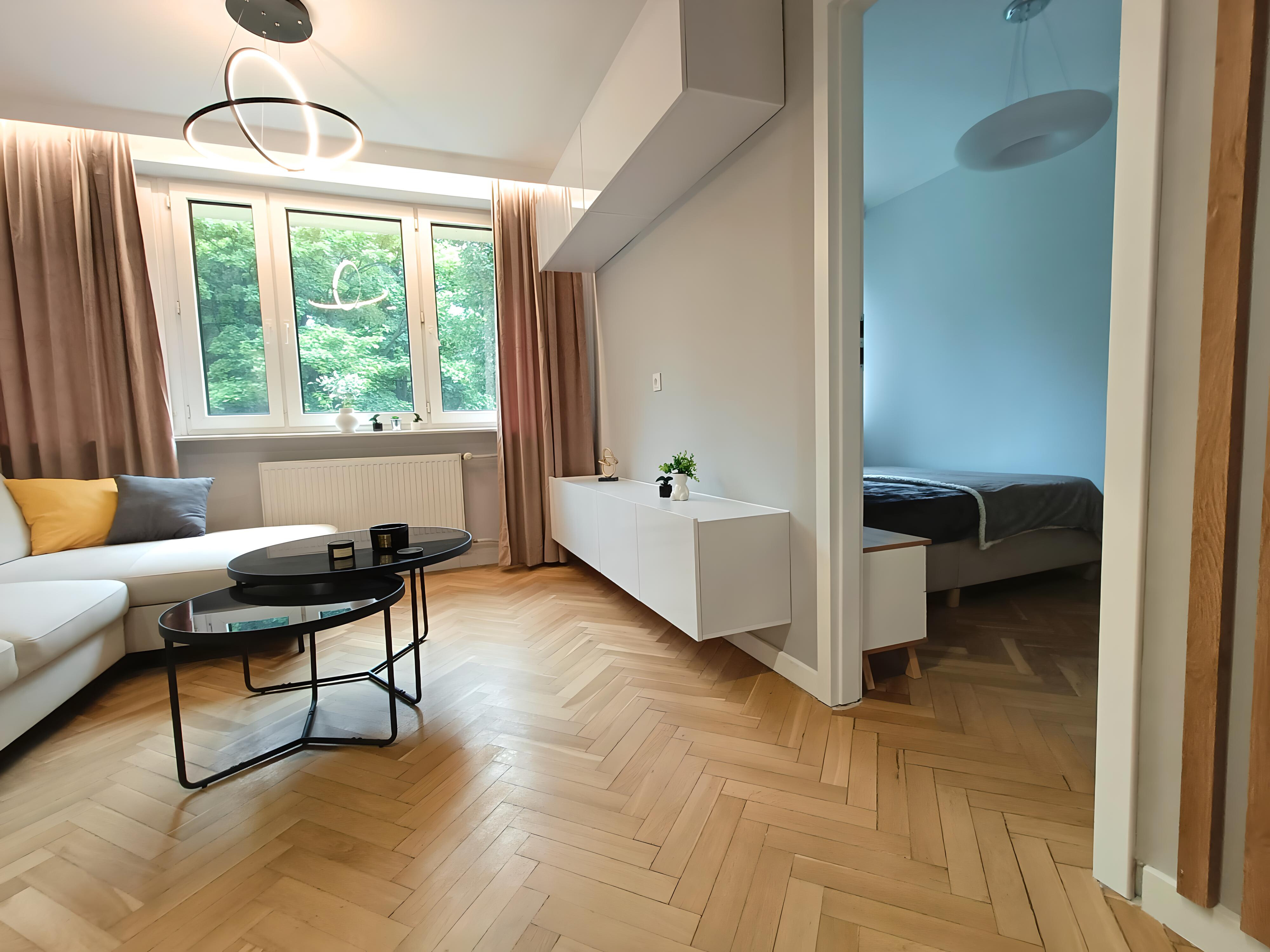
Buying for your own use
Prioritise commute, international travel, schools or healthcare where relevant, building accessibility, year-round comfort and resale demand. Start with the best districts to live in Warsaw and the wider relocation guide, then test the shortlist street by street.
Buying as an investment
Model achievable rent, vacancy, management, service charges, furnishing, Polish ryczałt and UK reporting before comparing gross yields. Use the Warsaw rental-income guide and investment district comparison as the next layer.
Questions British buyers ask before purchasing in Warsaw
Concise answers to the points that should be resolved before the first binding payment.
Can a British citizen buy an apartment in Warsaw after Brexit?
Yes. UK citizens are now within Poland’s general non-EEA regime, but acquisition of a self-contained residential apartment is normally exempt from the ministerial permit requirement. The exact title — including parking, storage and land rights — must still be reviewed.
Does a UK buyer need Polish residency or a PESEL to own an apartment?
Polish residency is not a general condition for owning a standard, permit-exempt apartment. Identification and tax or land-register data requirements are separate administrative questions and should be confirmed by the notary for the specific transaction. Ownership itself does not grant immigration status.
Does a British buyer need a permit for a house in Warsaw?
Potentially yes, because a house purchase normally includes land and falls outside the simple apartment exemption. A personal statutory exemption may still apply. Confirm the route before signing a reservation or preliminary agreement.
Can the entire purchase be completed from the UK?
Often it can be completed through a transaction-specific power of attorney accepted by the Polish notary. The execution may require a UK notary, apostille and Polish translation. Finalise the wording and formalities with the completing notary before signing in the UK.
Can a UK resident obtain a mortgage in Poland?
It may be possible, but lender choice and terms are narrower and depend on residence, income currency, employment, deposit, credit evidence and the property. Secure an individual financing assessment early and do not treat a general indication as approval for every property.
Where does a UK resident pay tax on rent from a Warsaw property?
Poland taxes rental income from Polish property. A UK resident normally also reports foreign property income to HMRC, with double-tax relief potentially available under UK rules and the UK–Poland treaty. The Polish and UK calculations are not identical, so both must be prepared.
Is a Polish notary the same as the buyer’s lawyer?
No. The notary performs a public legal function and prepares or authenticates the notarial deed; the notary is not a substitute for independent buyer-side legal advice, negotiation and due diligence.
Planning a Warsaw purchase from the UK?
We coordinate the search, verification, negotiation, legal workstream and completion locally, with a clear English-language audit trail.
Move from GBP planning to a controlled Warsaw purchase.
Tell us where you are in the process. We will respond with the next practical step for your purchase from the United Kingdom, not a generic sales sequence.
- Property search and off-market screening
- Offer, title and permit-risk coordination
- Cross-border funding and payment alignment
- Remote signing, closing, delivery and management
Verified and updated: 14 August 2026. Legal and tax claims are linked directly at the point of use to Polish government, UK government or official treaty sources.
Primary sources: Polish Ministry of the Interior, Polish Ministry of Justice, Polish Ministry of Finance, GOV.UK Living in Poland, HMRC foreign-income guidance, and the UK–Poland tax convention.
This guide is general information, not individual legal, tax, mortgage or immigration advice. Property title, residence, marital status, source of funds and intended use can change the result; obtain transaction-specific advice before signing.
Related guides & services