


Buying property
in Warsaw
from the USA.
A verified route for American buyers — Polish permit rules, remote closing, USD-to-PLN funding, Warsaw due diligence and the U.S. tax and foreign-account obligations that continue after completion.
Yes — a U.S. citizen can buy property in Warsaw. Americans are treated as non-EEA buyers under Polish law, but a major statutory exemption normally allows a foreign individual to acquire a self-contained residential apartment without a permit from the Minister of the Interior. Poland’s official English-language guidance states the general rule and lists the apartment exemption directly: Ministry of the Interior and Administration — acquisition by foreign citizens.
The legal object being acquired is decisive. A separately registered apartment in Warsaw is usually permit-exempt; a house with land, development plot or unusual co-ownership structure may require ministerial permission unless another exemption applies. The title, garage, storage and land rights must therefore be checked before any reservation payment becomes non-refundable.
Completed transaction: see how we sourced, negotiated, renovated and rented a Mokotów apartment for an investor based in the United States.
An American buyer normally needs neither Polish residence nor a property-acquisition permit to buy a standard, separately registered apartment in Warsaw. A house or land is different and may require a permit. Buying a Polish property does not remove U.S. filing obligations: the IRS confirms that U.S. citizens and resident aliens are generally taxed on worldwide income, including foreign rental income and gains.
When an American buyer needs permission — and when they do not
The answer depends on the registered property right, not the wording used in an online listing.
| What you are acquiring | Typical U.S.-buyer position | What must be verified |
|---|---|---|
| Separately registered residential apartment in Warsaw | Normally exempt | The unit is legally self-contained and the title fits the statutory apartment exemption. |
| Garage premises or parking share linked to the apartment | Structure check | Whether the garage right is separate and whether it falls within the housing-needs exemption described by the Ministry. |
| Detached or semi-detached house with land | Permit may apply | The land title, area, location, buyer’s Polish residence history and any personal exemption. |
| Development plot, land share or mixed-use title | Permit likely relevant | Exact cadastral and land-register rights; confirm the route before reserving. |
| Property in a border zone or qualifying agricultural land | Specialist review | The statutory exemptions are restricted for the cases identified in Article 8(3). |
Why Americans start under the non-EEA rules
The broad nationality-based exemption covers EEA and Swiss purchasers, not U.S. citizens. An American buyer therefore relies on a property-specific exemption — most commonly the individual apartment exemption — or on a personal exemption such as qualifying long-term residence or marriage circumstances. The current rules and government fee are published on the official Ministry page.
If a permit is required
The application must identify the buyer, seller, property, intended use and source of funds, and show circumstances connecting the buyer with Poland. The currently published stamp duty for a real-estate permit is PLN 1,570. The transaction timetable and preliminary agreement must allow for the administrative process rather than assuming a standard apartment closing.
A unit marketed to an American as a condo or apartment can still involve a commercial title, land co-ownership or a separate garage right. Ask for the land-and-mortgage-register number and have the acquisition object checked before sending a non-refundable deposit.
The Warsaw buying process for a U.S.-based purchaser
Run legal classification, due diligence, funding and closing logistics in parallel — before the offer becomes binding.
Define the brief in PLN and USD
Set the purchase budget, acquisition-cost reserve, exchange-rate buffer, intended use and holding period. Separate personal-use priorities from investment assumptions.
Confirm the permit route
Establish whether the target is a separate apartment, a house with land or another ownership right. Do this before signing any reservation document.
Search, view and compare
Assess micro-location, building condition, service charges, realistic rent, renovation exposure and exit demand — not only list price or cost per square metre.
Run independent legal and technical checks
Review the land register, seller authority, mortgages, claims, developer documents, arrears, contract, technical condition and handover risks.
Negotiate and document protections
Record price, inclusions, payment mechanics, possession, completion conditions, remedies and any permit or financing condition explicitly.
Prepare funds and closing authority
Complete source-of-funds checks, translations, apostille and power-of-attorney formalities; agree the payment sequence with the notary and seller.
Complete and register ownership
The transfer is executed in a Polish notarial deed. The land-register application, handover, meters, insurance, utilities, fit-out and management then follow from a written completion plan.

Use the dedicated Buying Process in Warsaw guide for the contract sequence, then apply the U.S.-specific tax, foreign-account and document overlay from this page.
Can an American buy in Warsaw without flying to Poland?
Often yes — through a transaction-specific power of attorney approved in advance by the Polish notary handling the deed.
Apostille depends on where the U.S. document originates
Poland and the United States are parties to the Hague Apostille Convention. The Polish Embassy confirms that a U.S. public document can be used in Poland once the appropriate local authority issues an apostille: Poland in the USA — Apostille. For state documents, the competent authority is tied to the issuing state; federal documents follow the U.S. Department of State route described in its official apostille requirements.
Because state procedures differ, the Polish notary should first approve the exact power-of-attorney wording and execution method. Do not notarize a generic online form and assume it will transfer Polish real estate.
Remote-closing control list
- Passport details and addresses match every contract and bank instruction.
- The Polish notary approves the power and apostille route before U.S. signing.
- A Polish translation is prepared in the form accepted for the deed.
- The authority covers only the required contract, payment, filing and handover acts.
- Source-of-funds evidence is complete before the large transfer is initiated.
- The buyer receives the signed deed, filing evidence and handover pack promptly.
Video viewings and a digital data room make the process efficient, but they do not replace independent legal review, technical inspection where appropriate or a controlled handover. Every approval, payment instruction and property document should be traceable.
Costs an American buyer should model before making an offer
Build the complete PLN requirement first, then calculate the USD needed at a realistic exchange rate.

| Cost | Resale apartment | Developer apartment | U.S.-buyer note |
|---|---|---|---|
| PCC transaction tax | Normally 2% unless an exemption applies | Normally not charged where the sale is VAT-taxed | First-home relief depends on every buyer’s ownership history, including rights held abroad. |
| VAT | Normally not added to a private resale | Embedded in the developer’s gross price | Confirm treatment of parking, storage and any commercial component. |
| Notary fee | Statutory maximum scale plus VAT | Statutory framework; specific rules can affect developer documents | Obtain the exact gross quote in writing. |
| Land-register fees | Fixed court fees based on applications | Fixed court fees based on applications | The notarial deed normally includes the filing request. |
| Buyer-side advice | Legal, technical and property representation as scoped | Contract review, snagging and representation as scoped | Use advisers owing their duty to the buyer. |
| Currency and banking | USD/PLN spread, wire fee and timing risk | Same, often across staged payments | Compare the final PLN delivered, not the headline exchange rate. |
| Permit application, if required | PLN 1,570 government stamp duty at the published rate | Property-dependent | Do not confuse the permit fee with legal or translation costs. |
The Polish Ministry of Finance publishes the 2% PCC rate for sales of real estate and specified residential rights: official PCC rates and limits. Maximum notary remuneration is governed by the official notarial-fee regulation; the actual gross quote should be confirmed before closing.
Combine price, statutory costs, advice, currency conversion, renovation or fit-out, financing, initial vacancy and a post-completion reserve. The complete taxes and fees guide and total-cost model expand every line.
USD transfers and mortgage reality
A Polish closing is funded in PLN. The American buyer’s exposure is the number of dollars required to deliver the agreed złoty on time.

Control the USD/PLN conversion
Fix the working budget in both currencies, include an exchange-rate buffer and compare banks or regulated payment providers on the final PLN received. Reconfirm beneficiary details through a trusted channel before wiring a large amount, and retain the full trail of statements, contracts and conversion confirmations.
Currency also affects U.S. reporting. The IRS requires taxpayers whose functional currency is the dollar to translate foreign income, expenses and taxes into U.S. dollars under the applicable rules: IRS — foreign currency and exchange rates.
Can a U.S. resident obtain a Polish mortgage?
Potentially, but lender availability is narrower and policy-specific. Polish banks assess residence, employment, income currency, deposit, credit evidence, age, property and documentation individually. USD income can restrict available products, and a preliminary indication should not be treated as approval for every apartment.
Start financing before the search becomes time-critical. Compare the required equity, total borrowing cost, valuation, insurance, early-repayment terms and the risk of servicing PLN debt from USD income. See the mortgage guide for foreign buyers.
Confirm currency, beneficiary, transfer reference, bank cut-off, cleared-funds requirement and the contractual result of late arrival. Never rely on a bank-detail change received only by email.
Polish tax and U.S. federal reporting operate in parallel
Poland taxes the Warsaw property as the source country. The United States generally continues to tax its citizens and resident aliens on worldwide income.
Rental income in Poland
Private rental revenue from Polish property is taxed under the ryczałt system at 8.5% up to PLN 100,000 of annual revenue and 12.5% above, according to the current Polish Ministry of Finance rental guidance. This is a revenue-based system; the detailed Polish rules determine which tenant payments form the landlord’s taxable revenue.
The IRS instructs owners to report rental real estate through Schedule E and expressly provides for a foreign property address: 2025 Schedule E instructions. U.S. income and expense calculations differ from the Polish ryczałt base.
Foreign tax credit and depreciation
Polish income tax may support a U.S. Foreign Tax Credit, subject to eligibility and limitation rules. The IRS explains that individuals generally calculate the credit on Form 1116; it is not an automatic dollar-for-dollar refund.
Tangible property used predominantly outside the United States is generally depreciated under ADS. Current Form 4562 instructions state a 30-year ADS recovery period for residential rental property placed in service after 2017. Land is not depreciable, and the PLN purchase price and later costs must be translated consistently into the U.S. tax basis. Use a cross-border CPA from the acquisition year, not only when rent begins.
The IRS lists the 1974 U.S.–Poland income tax treaty as the treaty currently in force. Article 7 allows income and gains from real property to be taxed where that property is situated. U.S. worldwide-income rules and foreign-tax-credit mechanics still need to be applied, and state treatment should be checked separately.
Sale of the Warsaw property
Poland generally taxes a private sale made within five years counted from the end of the calendar year of acquisition at 19% of the taxable gain; after that period a standard private sale falls outside Polish PIT. The Ministry of Finance explains the timeline and PIT-39 filing in its official property-disposal guidance, updated 24 June 2026. A Polish exemption does not by itself create a U.S. exemption: U.S. basis, depreciation recapture, exchange-rate effects, federal capital-gain rules and possible state tax require a separate calculation.
Owning the apartment is not the same as reporting the accounts
Direct foreign real estate, a Polish bank account and an interest in a foreign company are three different U.S. reporting categories.
| Asset or structure | General U.S. reporting point | Official source |
|---|---|---|
| Warsaw apartment owned directly in the individual’s name | Foreign real estate itself is not a specified foreign financial asset reported on Form 8938. | IRS Form 8938 Q&A |
| Polish bank account used for rent, charges or reserves | FBAR may be required when aggregate foreign financial accounts exceed $10,000 at any time during the calendar year. | IRS FBAR guidance |
| Interest in a Polish company, partnership, trust or other foreign entity holding the property | The entity interest may be a reportable foreign financial asset if the applicable Form 8938 threshold is exceeded; other international forms may also apply. | IRS Form 8938 Q&A |
| Polish rental income and expenses | Generally reported in U.S. dollars on the federal return, normally through Schedule E for individual rental real estate. | IRS Schedule E instructions |
The threshold applies to the combined maximum value of reportable foreign accounts, not separately to each account, and whether the account generated income does not determine whether it is reportable. FBAR is filed separately from the federal income-tax return. Confirm filing obligations with a U.S. international-tax professional.
Due diligence before any payment becomes non-refundable
The Polish land-and-mortgage register is the beginning of the investigation, not the whole investigation.
The Polish Ministry of Justice explains that the register contains four sections covering property identification and connected rights, ownership, rights and claims, and mortgages. It also links to the official online register: Gov.pl — land-and-mortgage-register information.
Ownership and seller authority
Confirm the registered owner, marital or corporate authority, acquisition basis and exact right being sold.
Claims and mortgages
Review Sections III and IV, pending mentions, releases and the debt-discharge sequence.
Area and appurtenant rights
Match the unit, storage, parking, common-property share and cadastral data to the contract and physical property.
Arrears and possession
Check building charges, utilities, occupants, leases, handover conditions and documents required at completion.
Technical condition
Inspect the apartment and relevant common areas; price defects, planned works and reserve-fund exposure.
Developer package
Review title, prospectus, permits, timetable, payment protection, completion standard and delay remedies.
U.S. State Department guidance for consular staff notes that consular officers cannot perform legal services for citizens, although posts may provide lists of local attorneys. The buyer needs independent Polish counsel responsible for the transaction: 7 FAM 660 — Real Property Inquiries.
Choose the property around the objective
A relocation buyer, a frequent Warsaw visitor and a dollar-based landlord require different locations, buildings and management models.
Buying for personal use
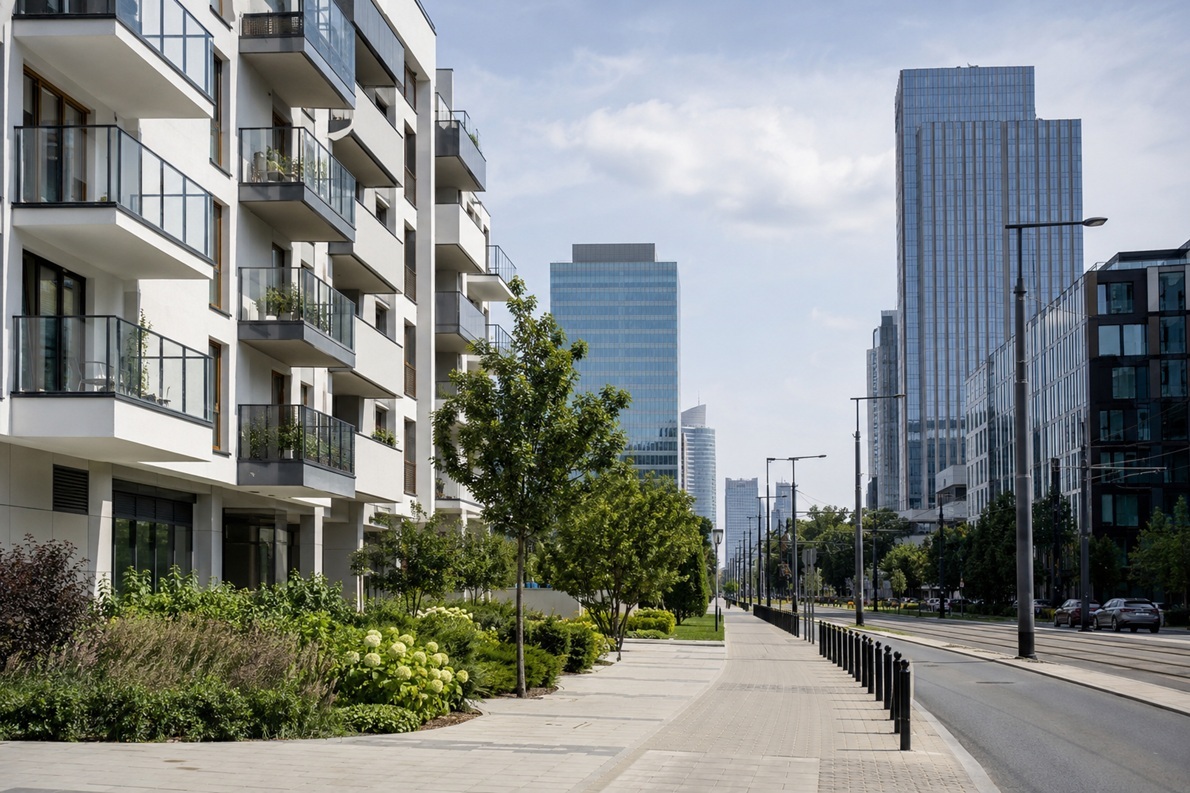
Prioritize commute, airport access, schools or healthcare where relevant, building accessibility, year-round comfort and resale demand. Start with the best districts to live in Warsaw and the relocation guide, then verify the micro-location in person or through a documented local viewing.
Buying as an investment
Model achievable rent, vacancy, management, service charges, furnishing, Polish ryczałt, U.S. depreciation and compliance before comparing yields. Use the rental-income guide and investment-district comparison.
Questions American buyers ask before purchasing in Warsaw
Direct answers to the issues that should be resolved before the first binding payment.
Can a U.S. citizen buy an apartment in Warsaw?
Yes. A U.S. citizen is within Poland’s non-EEA regime, but acquisition of a standard self-contained residential apartment is normally exempt from the ministerial permit requirement. The exact title, parking, storage and land rights still require review.
Does an American need Polish residency or a PESEL to own an apartment?
Polish residency is not a general condition for owning a standard permit-exempt apartment. Identification and land-register requirements should be confirmed by the notary for the transaction. Property ownership itself does not grant immigration status.
Does a U.S. buyer need a permit for a house in Warsaw?
Potentially yes, because a house purchase normally includes land and falls outside the simple apartment exemption. A personal statutory exemption may still apply. Confirm the route before signing a reservation or preliminary agreement.
Can the purchase be completed from the United States?
Often yes, through a transaction-specific power of attorney accepted by the Polish notary. Depending on the document and state, U.S. notarization, an apostille and a Polish translation may be required.
Can a U.S. resident obtain a Polish mortgage?
It may be possible, but lender choice depends on residence, employment, income currency, deposit, credit evidence and the property. Obtain an individual assessment early and do not treat a general indication as approval.
Must an American report rent from a Warsaw apartment to the IRS?
Generally yes. U.S. citizens and resident aliens are subject to federal tax on worldwide income, and individual rental real estate is normally reported through Schedule E. Polish tax may support a Foreign Tax Credit subject to U.S. rules.
Does directly owning a Polish apartment trigger Form 8938?
The IRS states that directly held foreign real estate itself is not a specified foreign financial asset reported on Form 8938. A foreign entity holding the apartment can create a different result, and Polish financial accounts must be tested separately.
When does a Polish account trigger FBAR?
An FBAR is generally required when a U.S. person has a financial interest in or authority over foreign financial accounts whose aggregate value exceeded $10,000 at any time during the calendar year. The test covers all reportable foreign accounts together.
Is the Polish notary the buyer’s lawyer?
No. The notary performs a public legal function and prepares or authenticates the deed. Independent buyer-side legal advice, negotiation and due diligence remain separate.
Planning a Warsaw purchase from the United States?
We coordinate the search, verification, negotiation, legal workstream and completion locally, with a clear English-language audit trail.
Move from USD planning to a controlled Warsaw purchase.
Tell us where you are in the process. We will respond with the next practical step for your purchase from the United States, not a generic sales sequence.
- Property search and off-market screening
- Offer, title and permit-risk coordination
- Cross-border funding and payment alignment
- Remote signing, closing, delivery and management
Verified and updated: 14 August 2026. Legal and tax claims are linked directly at the point of use to Polish government, IRS or U.S. Department of State sources.
Primary sources: Polish Ministry of the Interior, Polish Ministry of Justice, Polish Ministry of Finance, IRS international-tax guidance, IRS FBAR guidance, and the U.S.–Poland treaty documents.
This guide is general information, not individual Polish or U.S. legal, tax, mortgage or immigration advice. Property title, tax residence, state residence, ownership structure and intended use can change the outcome; obtain transaction-specific advice before signing.
Related guides & services